攀
Character Story & Explanation
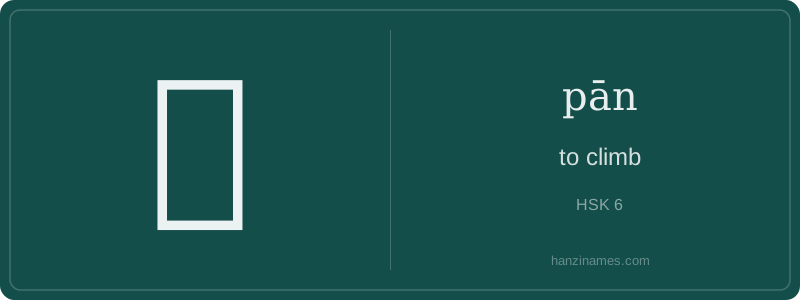
攀 is widely used in modern Chinese in both literal and figurative contexts: news headlines say '攀上新高峰' ('reach a new peak') about economic growth; job seekers talk about '攀爬职业阶梯' ('climb the career ladder'); and mountaineers ‘攀登珠峰’ (‘climb Mount Everest’) — a phrase featured in official CCTV reports since China’s first Everest ascent in 1960. It also appears in the classic idiom 攀龙附凤 (pān lóng fù fèng), meaning 'to curry favor with the powerful', dating back to the Han dynasty (206 BCE–220 CE).
The character’s earliest attested form appears in seal script (c. 3rd century BCE), where it already combines tree-like elements (symbolizing vertical obstacles) and hand (手), reflecting its core meaning of hand-assisted ascent. No oracle bone inscriptions survive for 攀, but its structure consistently emphasizes manual, upward effort across all historical scripts.
Hi students! The character 攀 (pān) means 'to climb' — not just physically, like climbing a mountain or ladder, but also metaphorically, like 'climbing the social ladder' or 'striving upward'. It’s a Level 6 HSK character, so it’s advanced but very useful for expressing ambition, effort, and upward movement. Notice its radical 手 (hand) — that tells us this action involves the hands and body working together to ascend.
With 19 strokes, 攀 looks complex, but it’s built from recognizable parts: two 'trees' (林) on top, then 奂 (huàn, an old form meaning 'to change/transform'), and finally the hand radical (手) at the bottom. This structure reflects the idea of using your hands to move up through layered obstacles — like branches or steps. Don’t memorize it stroke-by-stroke yet; first, anchor it to real-life actions you know.
Think of 攀 as active, intentional climbing — not passive rising. You 攀 a wall, 攀 a career path, or even 攀 fame. It implies effort, skill, and sometimes risk. Unlike simpler verbs like 爬 (pá, 'to crawl/climb casually'), 攀 suggests purpose and difficulty. That’s why it appears in formal writing, literature, and idioms about aspiration — making it essential for advanced learners aiming for natural, nuanced expression.
Example Sentences
Common Compounds
Similar Characters — Don't Mix These Up
Your First Step into Chinese Culture: Get a Chinese Name
Every journey into Chinese begins with a name. Use our free Chinese name generator to create a meaningful, personalized Chinese name that fits you perfectly.
Get My Chinese Name →