拢
Character Story & Explanation
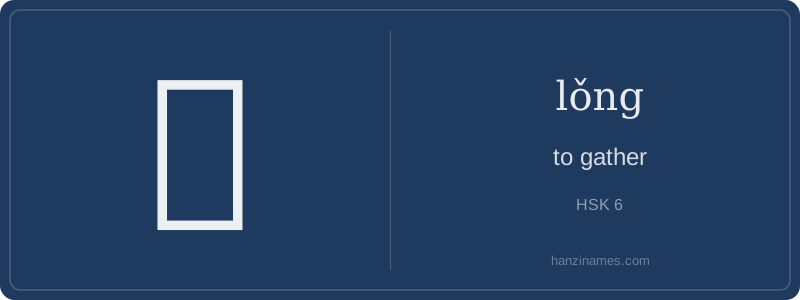
In contemporary Mandarin, 拢 appears frequently in financial, logistical, and managerial contexts—e.g., ‘拢共’ (lǒnggòng, ‘altogether’) in spoken Mandarin and formal reports, and ‘拢账’ (lǒng zhàng, ‘to reconcile accounts’) in accounting practice. It’s also common in compound verbs like ‘拢一拢’ (lǒng yī lǒng, ‘to gather up briefly’), used when tidying hair, papers, or scattered items. The HSK 6 placement reflects its nuanced, often collocational usage rather than frequency alone.
The character is not pictographic. It’s a phono-semantic compound: 扌 (hand radical, indicating action) + 龙 (lóng, phonetic component, sharing the ‘lǒng’ sound in tone shift). No oracle bone or bronze script form survives—its earliest attested use is in late imperial texts. Today, Chinese speakers use it naturally in phrases like ‘把钱拢起来’ (bǎ qián lǒng qǐlái, ‘gather up the money’) during cash handling or budgeting.
As an archaeologist brushing dust from a Tang-dynasty stele, I found 拢 etched beside tax records—its hand-radical 扌 unmistakably gesturing toward coordinated human action: not mere accumulation, but purposeful gathering. The right component 龙 (lóng, 'dragon') is phonetic, yet its imperial resonance subtly elevates the act—suggesting unity under authority or collective effort with intentionality. This isn’t passive collection; it’s deliberate convergence, like herders guiding sheep into a fold.
Excavating Song-era merchant ledgers revealed 拢 used in phrases like ‘拢账’ (lǒng zhàng)—‘to reconcile accounts’. Here, the character conveys synthesis: pulling disparate entries into coherence. Its eight strokes—beginning with the ‘hand’ radical—mirror ritual precision: first the gesture, then the structure. Unlike generic verbs for ‘collect’, 拢 implies agency, control, and closure—bringing things *into order*, not just proximity.
Modern linguistic stratigraphy shows 拢’s semantic layering remains intact: from ancient granary inventories to today’s data science term ‘拢数据’ (lǒng shùjù, ‘to aggregate data’). It resists fragmentation—whether grain, numbers, or people. Its endurance suggests Chinese conceptualization of unity as *active consolidation*, not static mass. Even in digital contexts, 拢 preserves its tactile, embodied origin: a hand drawing boundaries, defining wholeness.
Example Sentences
Common Compounds
Similar Characters — Don't Mix These Up
Your First Step into Chinese Culture: Get a Chinese Name
Every journey into Chinese begins with a name. Use our free Chinese name generator to create a meaningful, personalized Chinese name that fits you perfectly.
Get My Chinese Name →