搀
Character Story & Explanation
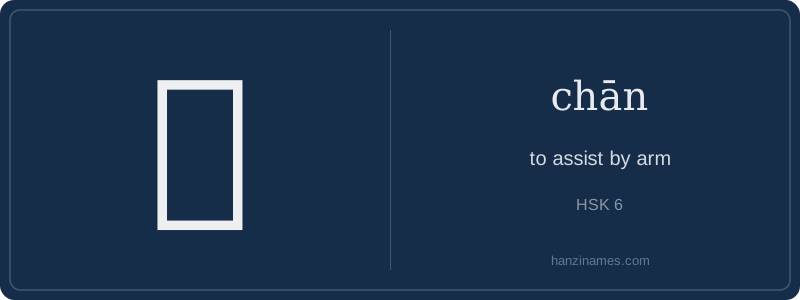
In modern Mandarin, 搀 is used almost exclusively in spoken and literary contexts to denote physically supporting someone—especially elders, the ill, or children—by the arm or elbow. It appears in standard phrases like 搀扶 (chānfú, 'to support with the arm'), widely taught in HSK 6 curricula and found in CCTV health documentaries demonstrating elder-care techniques. The character rarely appears in formal writing outside medical or caregiving domains.
The written form evolved from seal script where 扌 (hand) combined with a phonetic component derived from 餐 (cān, 'meal'), now visually simplified to 餐’s top portion. Though not pictographic, its structure reflects the historical link between feeding and caring—a documented semantic thread in classical texts like the Book of Rites, where assisting elders to dine was a ritual act of reverence.
As an archaeologist brushing dust from a Tang-dynasty stele fragment, I uncover 搀 not as a static glyph, but as a gesture fossilized in ink: the left radical 扌—'hand'—anchors the character in embodied action, while the right component 餐 (cān) originally signified 'to partake of food', later simplified and repurposed phonetically. This pairing suggests ancient recognition that physical support—like guiding an elder to the banquet table—was inseparable from care and shared sustenance.
Excavating further into Song-era medical manuscripts, I find 搀 consistently describing clinical assistance: physicians ‘chān’ patients during acupuncture positioning or post-surgery ambulation. The character’s twelve strokes map a precise choreography—three hand-movement strokes followed by nine structural elements—mirroring how Ming dynasty acupuncturists documented assisted posture transitions in therapeutic protocols.
The radical 扌 appears in over 1,200 characters related to manual interaction, yet 搀 stands apart: unlike 推 (push) or 拉 (pull), it encodes reciprocity and vertical social awareness—assisting upward, not directing. Its HSK 6 status reflects linguistic rarity: it survives not in bureaucratic texts, but in intimate, intergenerational contexts—like Qing dynasty family letters where daughters describe ‘chān’ mothers up temple steps, a quiet testament to filial duty rendered kinesthetic.
Example Sentences
Common Compounds
Similar Characters — Don't Mix These Up
Your First Step into Chinese Culture: Get a Chinese Name
Every journey into Chinese begins with a name. Use our free Chinese name generator to create a meaningful, personalized Chinese name that fits you perfectly.
Get My Chinese Name →