旨
Character Story & Explanation
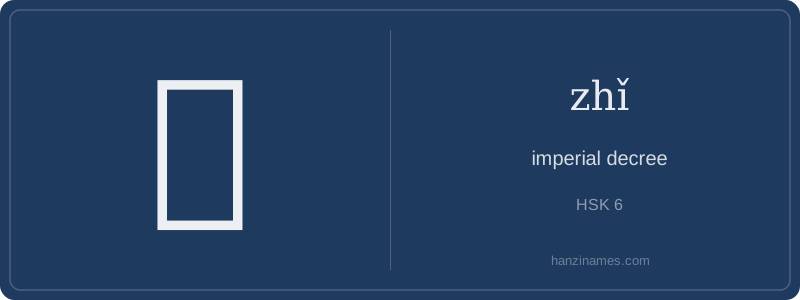
In historical usage, 旨 appears in formal compounds like 圣旨 (shèngzhǐ, 'imperial decree')—documented in Ming and Qing archives, where such edicts were issued on yellow silk with vermilion seals and read aloud in ritual tones. Today, it survives almost exclusively in literary, legal, or ceremonial contexts: government white papers cite 'the original intent of the policy' as 政策宗旨 (zhèngcè zhǐzhǐ), and classical idioms like 不得旨意 (bù dé zhǐyì, 'without official authorization') remain in legal discourse. It is rarely used alone in speech.
The character’s structure is well-documented: 日 (rì, 'sun') as radical (top) + 甘 (gān, 'sweet') as phonosemantic component (bottom). Oracle bone and bronze inscriptions confirm this composition by late Western Zhou (c. 9th century BCE). The 'sweet' element conveys 'what is fitting and thus accepted without resistance'—not literal taste, but normative harmony.
As an archaeologist brushing dust from a Tang-dynasty stele, I find 旨 inscribed in elegant clerical script—not as a sun glyph, but as a deliberate fusion of 日 (sun/day, symbolizing celestial authority) and 甘 (sweetness, implying the pleasing, unassailable weight of imperial will). This character wasn’t born of pictorial simplicity; it emerged in early bronze inscriptions as a semantic compound, marking edicts so authoritative they were deemed ‘as natural and inevitable as daylight’—a linguistic fossil of bureaucratic sanctity.
The radical 日 anchors 旨 in cosmic legitimacy: emperors ruled by the Mandate of Heaven, and their decrees carried solar inevitability. The lower component, though often misread as 甘, is actually a stylized variant of 甘 in seal script—confirming its original link to ‘what is agreeable and thus binding’. Excavated Han bamboo slips show 旨 used exclusively in chancellery documents, never in private letters—a testament to its institutional gravity.
Unlike characters that softened over time, 旨 retained its austere form across 2,300 years. Even today’s simplified script preserves all six strokes intact—no simplification applied. That rarity signals cultural reverence: this was not a word for daily chatter, but for edicts carved on stone, sealed with vermilion, and read aloud in court. Its stability mirrors the Confucian ideal of enduring moral authority—unchanging, luminous, and non-negotiable.
Example Sentences
Common Compounds
Similar Characters — Don't Mix These Up
Your First Step into Chinese Culture: Get a Chinese Name
Every journey into Chinese begins with a name. Use our free Chinese name generator to create a meaningful, personalized Chinese name that fits you perfectly.
Get My Chinese Name →