旱
Character Story & Explanation
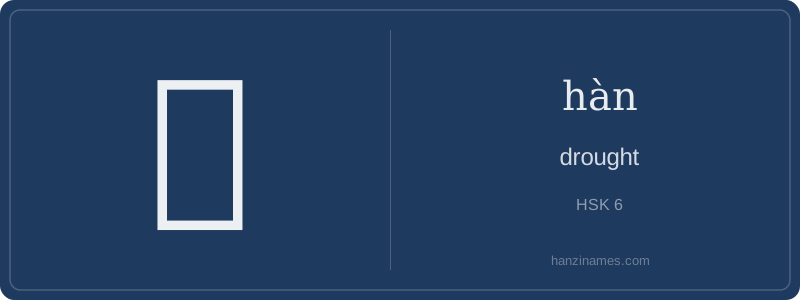
In contemporary China, 旱 is routinely used in national weather bulletins, agricultural advisories, and emergency management reports—especially in North China Plain provinces like Henan and Shandong, where recurrent droughts impact wheat production. It appears in official phrases like 旱情 (hànqíng, 'drought conditions') and the national policy term 抗旱救灾 (kàng hàn jiù zāi, 'drought resistance and disaster relief'). The idiom 旱涝保收 (hàn lào bǎo shōu, 'guaranteed harvest despite drought or flood') reflects centuries-old irrigation ambitions realized in projects like the South-to-North Water Diversion.
The character 旱 is a phono-semantic compound: its left radical 日 ('sun') signals semantic association with heat and sunlight, while the right component 干 (gān, 'dry') provides both sound (historically closer to *gān*; tone shift occurred) and meaning. Oracle bone and bronze inscriptions confirm its early use in Shang-Zhou divination records concerning failed harvests—verified in texts like the *Book of Documents* (Shūjīng), where 'drought' is listed among five major calamities (五灾).
The Chinese character 旱 (hàn) means 'drought'—a prolonged period of abnormally low rainfall leading to water shortage and agricultural stress. Unlike English, where 'drought' is a neutral meteorological term, 旱 carries strong socio-agricultural connotations in Chinese, historically linked to famine, imperial responsibility, and cosmic imbalance. Its radical 日 (rì, 'sun') visually underscores the scorching, sun-dominated cause of dryness—evoking relentless heat rather than mere absence of rain.
In classical Chinese thought, drought was often interpreted as a sign of moral failure by rulers or heaven’s displeasure—a concept absent in most Western secular frameworks. While Western cultures may frame drought through climate science or policy (e.g., California’s water rights debates), traditional Chinese records tied it to ritual responses: emperors issued self-censuring edicts (罪己诏), halted executions, and performed rain prayers at altars like the Temple of Heaven. This spiritual-political dimension remains embedded in literary and historical usage of 旱.
Modern usage retains this gravity: 旱 appears in official disaster reporting, climate policy documents, and media headlines—not as an abstract weather event but as a societal crisis demanding coordinated response. Compare this to Western equivalents like 'drought' (often technical) or 'dry spell' (colloquial and mild): 旱 inherently implies severity, urgency, and human consequence. Even in compound words like 抗旱 (kàng hàn, 'drought resistance'), the focus is on active, collective resilience—mirroring China’s long history of hydraulic engineering and state-led water management.
Example Sentences
Common Compounds
Similar Characters — Don't Mix These Up
Your First Step into Chinese Culture: Get a Chinese Name
Every journey into Chinese begins with a name. Use our free Chinese name generator to create a meaningful, personalized Chinese name that fits you perfectly.
Get My Chinese Name →