休
Character Story & Explanation
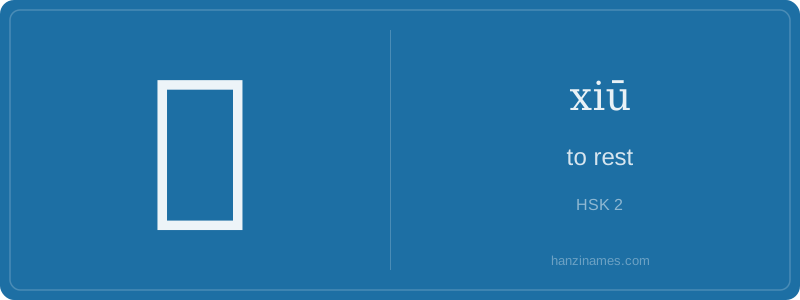
休 is ubiquitous in daily Chinese: on office doors marked ‘休息室’ (xiūxīshì, staff lounge), train station signs for ‘休息区’, and smartphone notifications saying ‘请稍作休息’ (qǐng shāo zuò xiūxī, ‘Please take a short break’). It appears in the classic idiom ‘休养生息’ (xiūyǎngshēngxī), dating to the Han Dynasty, describing post-war recovery through rest and nurturing—a policy principle documented in historical texts like the Book of Han. Modern usage includes ‘休假’ (xiūjià, paid leave), regulated under China’s Labor Law since 1995.
The character’s form is reliably attested in bronze inscriptions from the Western Zhou (c. 1046–771 BCE) and later seal script. It is a clear semantic-phonetic compound: 亻 (person) + 木 (tree, serving both meaning and sound component, as ancient pronunciations of 木 and 休 were closely related). No oracle-bone variant survives, but its structure has remained stable for over 2,700 years.
The character 休 (xiū) embodies a foundational Chinese philosophical ideal: harmony between humanity and nature. Its composition—a person (亻) leaning against a tree (木)—visually enacts rest not as idleness, but as a deliberate, grounded pause rooted in balance. In Confucian and Daoist thought, rest is not passive withdrawal but a necessary alignment with natural rhythms—like the tree that stands still yet grows deeply. This reflects a worldview where well-being arises from relational equilibrium, not individual exertion.
Unlike Western binaries of work/rest as opposites, 休 frames rest as integrally relational: one rests *with* or *because of* something—nature, community, or time itself. The tree isn’t just background; it’s an active partner in restoration. This mirrors classical Chinese concepts like yin-yang interdependence, where stillness (yin) enables dynamic action (yang). To rest is thus to acknowledge interconnection—to be human *in relation*, not in isolation.
This relational rest permeates Chinese social life: taking tea breaks together, observing seasonal holidays like Qingming (a time for both ancestor veneration and spring renewal), or pausing midday during summer heat. Even modern workplace culture retains echoes—‘work–rest balance’ (工作与休息的平衡) is a common phrase in HR policies, and national holidays emphasize collective recuperation. 休 is therefore not merely lexical—it’s a cultural grammar for sustainable living, teaching that true vitality flows from rhythmic stillness, not relentless motion.
Example Sentences
Common Compounds
Similar Characters — Don't Mix These Up
Your First Step into Chinese Culture: Get a Chinese Name
Every journey into Chinese begins with a name. Use our free Chinese name generator to create a meaningful, personalized Chinese name that fits you perfectly.
Get My Chinese Name →