但
Character Story & Explanation
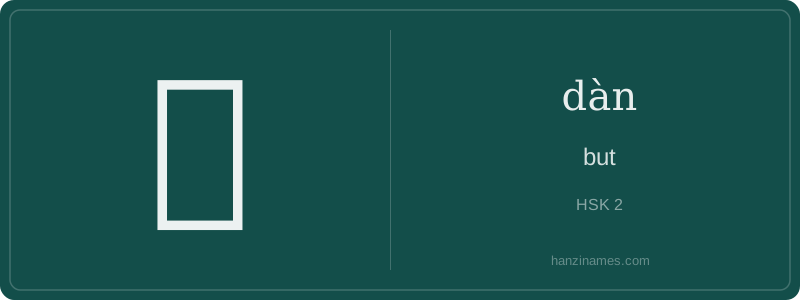
在现代汉语中,但 is one of the most frequently used conjunctions for contrast — appearing in formal writing, news reports, and daily speech. It’s central to HSK 2 grammar, commonly paired with 虽然 (although) in the '虽然…但…' structure (e.g., 虽然下雨,但比赛照常进行). Historical texts like the 13th-century Yuan Dynasty Legal Code already use 但 to introduce exceptions or qualifications, confirming its long-standing grammatical role.
The character’s form is not pictographic but phono-semantic: 亻 (person radical) signals human context, and 旦 (dàn, 'dawn') serves as the phonetic component — a documented borrowing from Old Chinese pronunciation. No oracle-bone or bronze inscriptions exist for 但; it first appears reliably in Han dynasty bamboo slips as a grammatical particle, evolving from earlier uses of 旦 meaning 'only' or 'just'.
Imagine walking through Beijing’s bustling Wangfujing Street on a rainy afternoon. You duck into a teahouse, warm and fragrant with roasted oolong. The server brings your order — a steaming cup of tea — but says gently, '但今天茶汤稍淡,师傅刚换新叶。' (Dàn jīntiān chá tāng shāo dàn, shīfu gāng huàn xīn yè.) Her 'but' signals a polite, graceful contrast: the tea is warm and welcoming, yet subtly different from usual — not a flaw, but a gentle nuance. This 'but' softens expectation, preserving harmony.
In Chinese communication, 但 rarely introduces harsh contradiction. Instead, it pivots with respect — like pausing mid-sentence to acknowledge both sides of a truth. A teacher might praise a student’s effort but add, '但下次注意标点符号。' (Dàn xià cì zhùyì biāodiǎn fúhào.) That 'but' isn’t criticism; it’s scaffolding — building on what’s already good. It reflects Confucian-influenced dialogue: affirm first, refine second.
The character’s structure reinforces this balance: the 亻 (person) radical grounds it in human interaction, while the right side (旦) originally meant 'dawn' — symbolizing a new phase emerging *despite* or *alongside* what came before. So 但 doesn’t erase the first clause; it adds dimension, like light breaking through clouds. Mastering it means mastering the rhythm of thoughtful, relational speech — where 'but' becomes a bridge, not a barrier.
Example Sentences
Common Compounds
Similar Characters — Don't Mix These Up
Your First Step into Chinese Culture: Get a Chinese Name
Every journey into Chinese begins with a name. Use our free Chinese name generator to create a meaningful, personalized Chinese name that fits you perfectly.
Get My Chinese Name →