晨
Character Story & Explanation
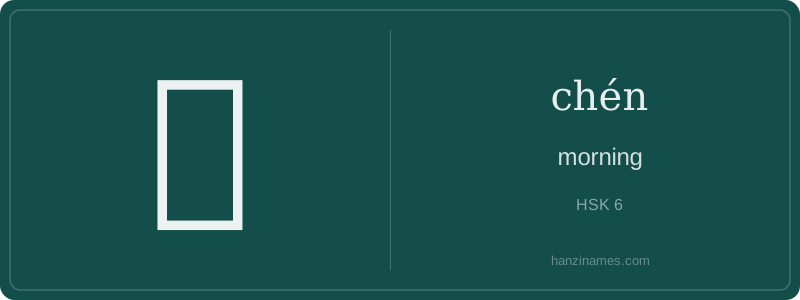
晨 is widely used in fixed expressions and formal registers: news headlines feature 晨间新闻 (chénjiān xīnwén, 'morning news'), schools hold 晨会 (chén huì, 'morning assembly'), and public parks fill with elders doing 晨练 (chén liàn, 'morning exercise'). The idiom 晨钟暮鼓 (chén zhōng mù gǔ, 'morning bell, evening drum') originates from Buddhist monastic discipline—documented since the Tang dynasty—and symbolizes disciplined timekeeping and mindfulness.
Historically, 晨 is a phono-semantic compound: the left radical 日 (rì, 'sun') signals meaning; the right component 辰 (chén) serves as both phonetic and semantic anchor—it originally depicted a constellation associated with dawn and was later used for the 'dragon' Earthly Branch hour (7–9 a.m.). No oracle bone form survives, but bronze inscriptions from the Warring States period confirm its use for early-morning rituals.
The Chinese character 晨 (chén) embodies the quiet, luminous transition from night to day—more than just 'morning' as a clock time, it evokes freshness, renewal, and ritualistic stillness. In classical texts like the Shijing (Book of Songs), 晨 appears in agrarian and poetic contexts, marking the hour when roosters crow and labor begins. Its connotation carries gentle urgency—not the rushed 'AM' of Western schedules, but a contemplative, almost sacred threshold.
Unlike English ‘morning’—a neutral temporal noun—晨 is inherently lyrical and formal. It rarely appears in casual speech (people say 早上 zǎoshang instead) but thrives in literature, titles, and set phrases like 晨光 (chén guāng, 'morning light') or 晨练 (chén liàn, 'morning exercise'). This reflects a cultural distinction: while Western mornings often signal productivity onset, 晨 emphasizes harmony with natural rhythm and inner preparation.
Western equivalents like ‘dawn’, ‘break of day’, or ‘matins’ come closest—but none fully capture 晨’s dual grounding in astronomy (sun + moon + forest, per its structure) and Confucian-influenced reverence for daily renewal. Even Christian ‘morning prayer’ lacks 晨’s secular-poetic versatility: it appears equally in Taoist alchemy texts, Tang dynasty poetry, and modern metro announcements—always implying clarity, intention, and unspoiled potential.
Example Sentences
Common Compounds
Similar Characters — Don't Mix These Up
Your First Step into Chinese Culture: Get a Chinese Name
Every journey into Chinese begins with a name. Use our free Chinese name generator to create a meaningful, personalized Chinese name that fits you perfectly.
Get My Chinese Name →