晰
Character Story & Explanation
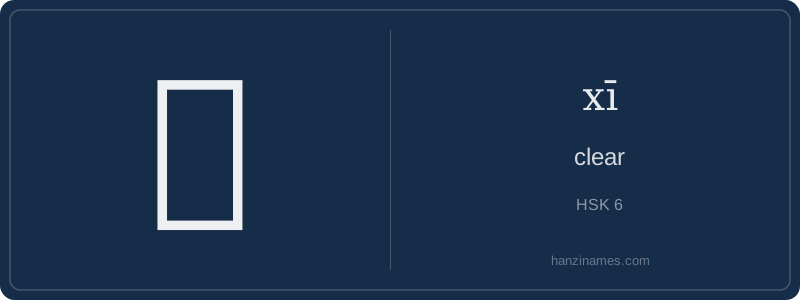
晰 is widely used in modern Chinese in contexts requiring precision: scientific reports ('图像清晰度', image resolution), legal documents ('事实清晰', facts are unambiguous), and education ('讲解清晰', explanation is lucid). It appears in standardized phrases like 条理清晰 (tiáolǐ qīxī, 'logically clear') and 脉络清晰 (màiluò qīxī, 'the thread is evident'), both common in HSK 6–level texts and official communications.
The character is a phono-semantic compound: radical 日 (sun, suggesting brightness/luminosity) + phonetic 析 (xī, 'to separate/analyze'). First attested in early medieval texts like the *Guangyun* (1008 CE), it was not in oracle bone or bronze inscriptions. Its form reflects Tang–Song scholarly emphasis on analytical clarity—no mythic origin, but a deliberate lexical innovation for conceptual precision.
晰 (xī) is a refined, literary character meaning 'clear'—not just visually sharp, but conceptually precise and logically transparent. Unlike the more common 清 (qīng), which conveys general clarity or purity (e.g., clear water), 晰 emphasizes perceptual acuity and intellectual lucidity: think 'crystal-clear reasoning' or 'high-definition visibility.' It appears frequently in formal writing, academic discourse, and technical descriptions where precision matters.
In Western thought, 'clarity' often maps to Greek *saphēneia* (transparency of truth) or Cartesian 'clear and distinct ideas.' But 晰 carries a distinctly Chinese epistemological weight—it implies clarity achieved through disciplined observation, aligned with Confucian ideals of careful discernment (明察, míngchá). It’s less about innate certainty and more about cultivated perceptual rigor.
Culturally, 晰 reflects the classical Chinese value of *míng* (明, brightness/clarity) as moral and cognitive virtue—not merely optical sharpness, but ethical transparency and analytical exactness. Its radical 日 (sun) anchors it in luminosity, while the phonetic component 析 (xī, 'to analyze') reinforces its link to logical dissection. This dual root makes 晳 uniquely semantic: clarity emerges not from passive perception, but from active, sun-lit analysis.
Example Sentences
Common Compounds
Similar Characters — Don't Mix These Up
Your First Step into Chinese Culture: Get a Chinese Name
Every journey into Chinese begins with a name. Use our free Chinese name generator to create a meaningful, personalized Chinese name that fits you perfectly.
Get My Chinese Name →