晶
Character Story & Explanation
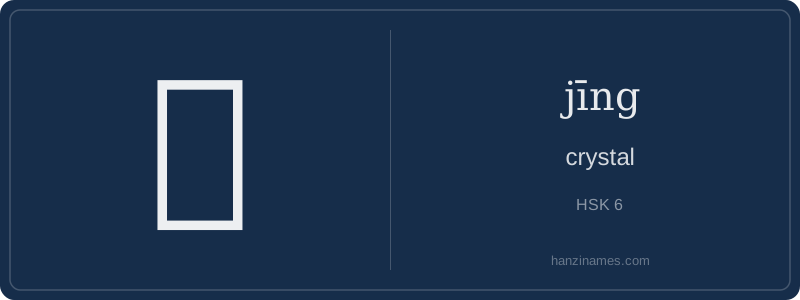
In modern usage, 晶 appears most frequently in scientific and commercial contexts: '液晶' (liquid crystal, LCD screens), '结晶' (crystallization), and '水晶' (rock crystal/quartz). It's central to HSK 6 vocabulary due to its role in compound terms describing physical states and optical properties. The idiom '冰清玉洁,晶莹剔透' (‘as pure as ice, as clean as jade—crystal-clear and translucent’) appears in classical poetry anthologies and contemporary textbooks alike, emphasizing moral and aesthetic transparency.
Graphically, 晶 is a clear logographic compound: three 日 (sun) radicals arranged symmetrically. This triple-repetition pattern is documented since the Warring States bamboo slips (475–221 BCE) and stabilized in Han dynasty seal script. It does not depict a physical crystal but evokes radiant, structured light—the visual essence of crystallinity in pre-scientific understanding.
As an archaeologist sifting through layers of Chinese script, I first encountered 晶 inscribed on Song dynasty ceramic glaze labels—its triple-sun motif gleaming under museum lights. This character isn’t a fossilized relic but a living stratigraphy: three 日 (rì, 'sun') radicals stacked like crystalline lattice planes, visually echoing the geometric clarity of quartz. Its structure predates printing; Tang calligraphers already treated it as a semantic amplifier—repetition not for redundancy, but for intensification, like light refracting through facets.
The radical 日 appears thrice—not by accident, but by design. In early clerical script (lìshū), scribes emphasized luminosity and purity through repetition, a technique also seen in characters like 森 (forest) and 品 (quality/taste). 晶 thus emerged not as a pictograph of crystal itself, but as a conceptual glyph: *light multiplied, ordered, unbroken*. It encodes ancient Chinese cosmology where celestial brightness symbolized moral clarity and natural perfection.
Unlike phonetic-semantic compounds, 晶 is a rare pure ideograph—its meaning arises entirely from form, not sound. Its pronunciation jīng coincides with other characters meaning 'essence' or 'refined substance' (e.g., 精), suggesting semantic convergence over centuries. Excavations at Kaifeng’s Northern Song imperial kilns revealed inkstone inscriptions reading '晶光如鏡' ('crystal light like a mirror'), confirming its use in technical descriptions of material brilliance—long before modern mineralogy.
Example Sentences
Common Compounds
Similar Characters — Don't Mix These Up
Your First Step into Chinese Culture: Get a Chinese Name
Every journey into Chinese begins with a name. Use our free Chinese name generator to create a meaningful, personalized Chinese name that fits you perfectly.
Get My Chinese Name →