晾
Character Story & Explanation
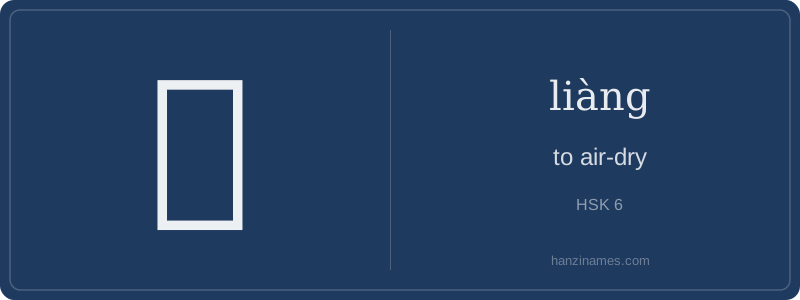
In contemporary China, 晾 is indispensable in daily life: people 晾衣服 (liàng yīfu, air-dry laundry), 晾被子 (liàng bèizi, sun blankets to kill mites), and even 晾茶 (liàng chá, sun-dry tea leaves for oolong processing). It appears in the common phrase 晾一晾 (liàng yī liàng)—literally 'dry-dry', meaning 'to let something sit awhile before acting', used in negotiations or emotional cooling-off periods. Historically, during the Ming dynasty, imperial edicts required silk garments to be 晾于北窗 (liàng yú běi chuāng, dried by north-facing windows) to prevent sun-bleaching.
The character is a phono-semantic compound: 日 (rì, sun) signals the semantic domain (sun-dependent drying), while 京 (jīng) provides the sound liàng. Though 京 originally meant 'capital city', here it functions purely phonetically—confirmed by rhyme tables in the Guǎngyùn (1008 CE). No pictographic origin exists; it’s a deliberate Song-period creation reflecting lexical need.
As an archaeologist brushing dust from a Tang-dynasty bamboo slip, I uncover 晾 not as a static glyph—but as a ritual of renewal. Its 日 (sun) radical anchors the action in celestial time: drying requires sunlight, patience, and atmospheric clarity. The right-hand component, 京 (jīng), originally depicted a high city or watchtower—here repurposed phonetically to signal liàng, yet subtly evoking elevation: clotheslines strung high, grain spread on rooftops, herbs hung from eaves. This is not mere verb—it’s a microcosm of human negotiation with weather and season.
The character first appears reliably in Song-era texts like the Jiězì Yùpiān (1039 CE), where it’s defined as ‘exposing to sun-wind to remove dampness’. No oracle-bone or bronze inscriptions bear 晾—its birth is pragmatic, post-classical, emerging alongside urban laundry culture and imperial textile oversight. Its 12 strokes encode a daily rhythm: three horizontal sweeps for sunbeams, four verticals for hanging rods, and five connecting motions mirroring the act of spreading, adjusting, retrieving.
Modern excavations of Beijing courtyard homes reveal faded ink inscriptions on wooden晾衣杆 (liàngyīgān, drying poles) from the 1920s—proof that 晾 was already embedded in domestic infrastructure. Even today, its stroke order (beginning with 日’s top horizontal) reflects ancestral logic: light must arrive *before* the object is exposed. To write 晾 is to reenact a 1,000-year-old covenant between humanity and humidity—no steam, no machines, just air, gravity, and solar grace.
Example Sentences
Common Compounds
Similar Characters — Don't Mix These Up
Your First Step into Chinese Culture: Get a Chinese Name
Every journey into Chinese begins with a name. Use our free Chinese name generator to create a meaningful, personalized Chinese name that fits you perfectly.
Get My Chinese Name →