暧
Character Story & Explanation
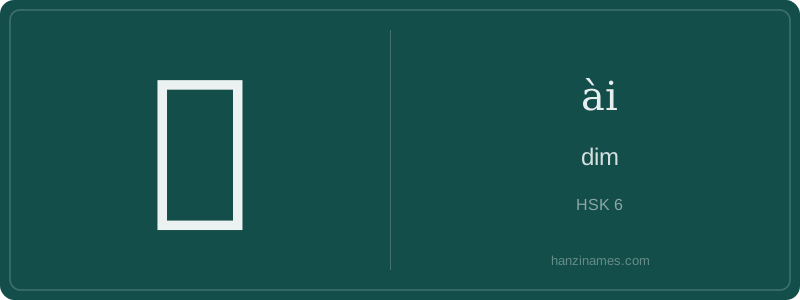
暖 (nuǎn, 'warm') is commonly confused with 暧, but they’re distinct: 暧 appears almost exclusively in fixed literary compounds like 暧昧 (àimèi), meaning 'ambiguous', 'vague', or 'coy' — historically used in classical texts to describe unclear moral or emotional situations. The earliest verifiable usage is in the Tang dynasty poet Li He’s works, where 暧昧 evokes indistinct moonlight or uncertain intentions. Today, it’s still used in legal and journalistic contexts to describe ambiguous evidence or relationships.
The character’s form has no oracle-bone or bronze inscription record. Its earliest attestation is in clerical script (Lìshū) from the Han dynasty, where 日 + 爱 already coalesced as a phonosemantic compound. In modern life, Chinese speakers most often encounter 暧 only in the word 暧昧 — e.g., when describing an unlabelled romantic relationship or politically vague statements on social media.
Our investigation begins with the radical 日 (rì) — 'sun' — anchoring 暧 in the domain of light and time. Yet this character doesn’t depict brightness; instead, it evokes its opposite: a sun veiled, obscured, or diffused — like dawn mist or twilight haze. The right side, 爱 (ài, 'to love'), is not semantic here but phonetic, providing the pronunciation clue while subtly reinforcing ambiguity: affection, like dim light, is often tender, indistinct, and layered.
The 14-stroke composition reveals deliberate balance: 日 occupies the left, compact and stable; the complex right component unfolds with controlled strokes — dot, horizontal, vertical, hook — mimicking atmospheric diffusion. Unlike sharp, clear characters (e.g., 明), 暧’s structure feels soft-edged, resisting clarity — a visual echo of its meaning: not darkness, but *lack of definition* in illumination.
This character belongs to HSK Level 6, reflecting its literary nuance and low-frequency usage in daily speech. It appears almost exclusively in poetic, descriptive, or classical contexts — never in technical manuals or casual chat. Its rarity makes it a linguistic fingerprint: when encountered, it signals intentional atmosphere-building, not mere description. Think of it as the Chinese equivalent of ‘gauzy’, ‘hazy’, or ‘luminous but indistinct’ — a lexical brushstroke for subtle perceptual states.
Example Sentences
Common Compounds
Similar Characters — Don't Mix These Up
Your First Step into Chinese Culture: Get a Chinese Name
Every journey into Chinese begins with a name. Use our free Chinese name generator to create a meaningful, personalized Chinese name that fits you perfectly.
Get My Chinese Name →