曝
Character Story & Explanation
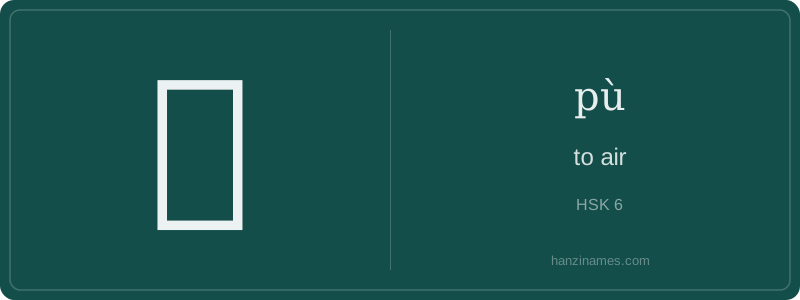
曝 (pù) appears frequently in practical, everyday contexts across China—especially in rural and semi-urban households. A well-documented usage is 曝被子 (pù bèizi), the widespread winter practice of airing quilts in strong sunlight to kill dust mites and eliminate dampness. Public health campaigns by the Chinese Center for Disease Control have endorsed this habit since the 1980s. The character also features in classical agricultural texts like the *Qimin Yaoshu* (535 CE), which prescribes 曝稻 (pù dào) — sun-drying harvested rice to prevent mold before storage.
The character’s structure is logographic and transparent: the left radical 日 (rì, 'sun') signals solar involvement; the right component 暴 (bào/pù) originally depicted hands holding a rice plant under the sun (in ancient forms), later standardized to mean 'to expose'. While oracle-bone script evidence for 曝 itself is absent (it emerged in seal script), its component 暴 appears in early Warring States bamboo slips referring to sun-exposure techniques for grain preservation.
The Chinese character 曝 (pù) primarily means 'to air'—specifically, to expose something to sunlight for drying, disinfecting, or preserving. Unlike the English verb 'air', which often implies ventilation or public disclosure, 曝 carries a strong physical, solar connotation rooted in daily life: airing quilts, drying tea leaves, or sun-curing fish. Its radical 日 (sun) visually anchors this meaning, reinforcing that exposure must involve direct sunlight—not just fresh air.
This character is distinct from its homophone 曝 (bào), used in media contexts like 'to expose a scandal' (曝光 bào guāng). Though identical in writing, the two readings reflect semantic divergence: pù emphasizes natural, beneficial exposure; bào implies revelation—often unwanted. This duality mirrors Western concepts like 'sun-drying' versus 'breaking a story', where context and tone determine interpretation.
In cultural comparison, 曝 (pù) aligns closely with traditional European practices such as linen airing on village lines in Provence or Japanese *hishaku* (sun-drying laundry), but differs from Anglo-American 'airing out a room', which rarely involves sunlight. Crucially, 曝 lacks the metaphorical leap into 'public exposure' unless paired with 光 (guāng) and read as bào. This precision reflects Chinese lexical economy: one glyph, two phonetic layers, two culturally grounded meanings.
Example Sentences
Common Compounds
Similar Characters — Don't Mix These Up
Your First Step into Chinese Culture: Get a Chinese Name
Every journey into Chinese begins with a name. Use our free Chinese name generator to create a meaningful, personalized Chinese name that fits you perfectly.
Get My Chinese Name →