旷
Character Story & Explanation
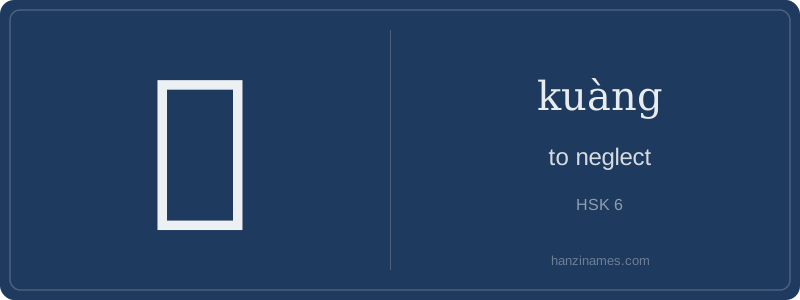
In contemporary China, 旷 is most commonly used in educational and professional settings to denote unauthorized absence. Teachers mark '旷课' (kuàngkè) on attendance sheets for students who skip class without leave; HR departments record '旷工' (kuànggōng) for unexcused work absences — both carrying formal disciplinary weight. The term appears in the Regulations on Disciplinary Measures for Staff (2020) and university student handbooks nationwide.
The character’s form is not pictographic but phono-semantic: 日 (rì, 'sun/day') is the semantic component suggesting time-related concepts, while 广 (guǎng, 'broad') serves as the phonetic hint (though pronunciation diverged over time). Historically attested in bronze inscriptions and the Shuōwén Jiězì (121 CE), it originally meant 'vast, open' — later extending to 'unoccupied' and then 'neglected' through semantic shift.
The character 旷 (kuàng) evokes images of vast, open spaces — literally 'sun' (日) over 'a person standing in an open field' (广). Though its modern meaning 'to neglect' may seem disconnected from openness, the semantic link lies in the idea of *leaving something unoccupied or unused*, like an abandoned field under the sun. This spatial emptiness metaphorically extends to time and duty: when responsibilities are left 'open' or unfilled, they are neglected.
At HSK Level 6, 旷 appears in formal and literary contexts, rarely in casual speech. It carries a tone of seriousness and consequence — not mere forgetfulness, but willful or consequential omission. Learners often confuse it with simpler synonyms like 忘 (wàng, 'to forget'), but 旷 implies structural absence: skipping class regularly, abandoning duties, or failing to fulfill obligations over time.
Its radical 日 (sun/day) anchors it in temporal concepts — days missed, time wasted. The 7-stroke structure is deceptively simple: 日 (4 strokes) + 广 (3 strokes), yet mastering its balanced proportions matters for legibility. In handwriting, the 广’s sweeping dot must hover lightly above the 日 without touching it — mirroring how neglect creates a subtle but critical gap between intention and action.
Example Sentences
Common Compounds
Similar Characters — Don't Mix These Up
Your First Step into Chinese Culture: Get a Chinese Name
Every journey into Chinese begins with a name. Use our free Chinese name generator to create a meaningful, personalized Chinese name that fits you perfectly.
Get My Chinese Name →