枚
Character Story & Explanation
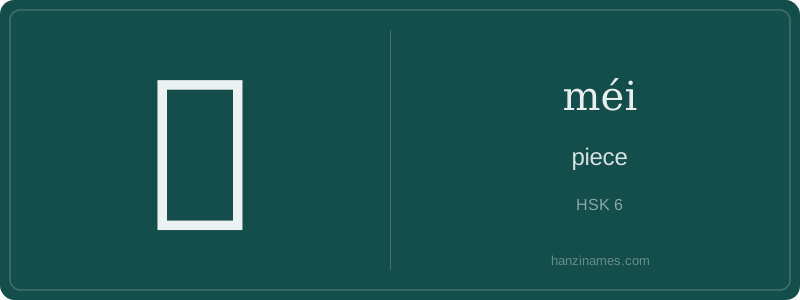
In modern Chinese daily life, 枚 (méi) appears routinely in formal contexts: bank tellers count commemorative coins as ‘yī méi’, museums label Qing dynasty jade bi discs as ‘sān méi’, and military awards are always quantified with ‘méi’. It’s mandatory in official publications like the People’s Daily and Xinhua News Agency when reporting on state honors or archaeological finds. While no common idioms feature ‘méi’, its fixed collocations—e.g., ‘yī méi yìnzhāng’ (one carved seal)—are codified in the《Modern Chinese Dictionary》(7th ed., 2016).
The character’s written form is not pictographic but phono-semantic: 木 (mù, ‘tree’) is the semantic radical (originally referencing wooden tally sticks used in Han dynasty record-keeping), and 攵 (a variant of 攴, ‘to strike’) plus 几 (jī, phonetic component hinting at ‘méi’) formed the ancient structure. By the Tang dynasty, it stabilized into today’s eight-stroke form, consistently used for small, discrete, often ceremonial objects.
Imagine walking through Beijing’s Panjiayuan Antique Market, where an elderly collector carefully lifts a Song-dynasty bronze coin from a velvet tray. He counts it aloud: ‘Yī méi, èr méi…’ — not ‘yī gè’, but ‘méi’, the precise classifier reserved for small, flat, historically significant objects like coins, seals, or jade pendants. This isn’t arbitrary grammar—it’s linguistic precision rooted in material culture.
‘Méi’ reflects China’s long tradition of valuing tangible, crafted artifacts. Unlike generic classifiers like ‘gè’, ‘méi’ implies formality, historical weight, and physical delicacy—think of a Ming dynasty seal carved from soapstone or a Qing-era silver ingot fragment. Its wooden radical (木) hints at early origins: many ancient seals and tally sticks were made of wood, later replaced by metal or stone—but the classifier endured.
Even today, official documents use ‘méi’ with strict consistency: a national medal is ‘yī méi zhōngguó rénmín jiěfàngjūn yīngxióng jìzhāng’ (one PLA Hero Medal), never ‘yī gè’. This usage signals respect and institutional recognition—proof that grammar encodes cultural hierarchy. For learners, mastering ‘méi’ means understanding how Chinese language honors objecthood, history, and craftsmanship in a single syllable.
Example Sentences
Common Compounds
Similar Characters — Don't Mix These Up
Your First Step into Chinese Culture: Get a Chinese Name
Every journey into Chinese begins with a name. Use our free Chinese name generator to create a meaningful, personalized Chinese name that fits you perfectly.
Get My Chinese Name →