备
Character Story & Explanation
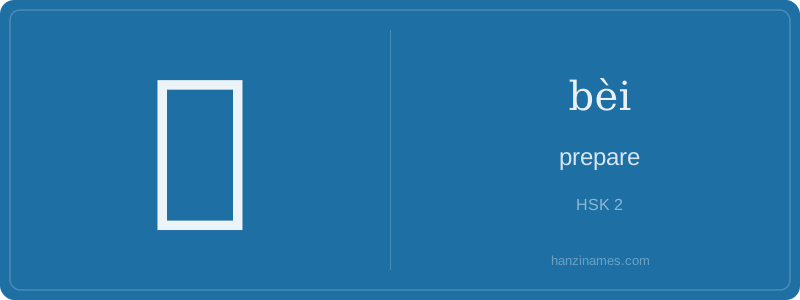
备 is widely used in modern Chinese for planning and readiness — especially in education, business, and public safety. It appears in official slogans like '防患于未然,有备无患' (‘Prevent trouble before it arises; preparedness prevents disaster’), a well-documented idiom dating back to the Song dynasty. In schools, students hear ‘考前要认真备考’ (‘Study seriously to prepare for exams’) — a phrase repeated nationwide. Government health advisories use 备药 (bèi yào, ‘stock medicine’) during flu season, reflecting its practical, everyday role.
The character 备 evolved from seal script (c. 3rd century BCE), where it combined 夂 (movement toward) with 田 (field) and 咅 (a phonetic component). By the Han dynasty, it standardized into its current form — no longer pictographic, but clearly semantic-phonetic. Today, Chinese learners practice it early because of its high functional frequency, not ancient symbolism.
Hi students! The character 备 (bèi) is a foundational HSK Level 2 word meaning 'to prepare' or 'to equip'. It’s used constantly in daily Chinese — from packing for a trip to setting up equipment before a meeting. Though it looks simple with just 8 strokes, its meaning is rich and active: it always implies intentional readiness, not passive waiting. You’ll see it in verbs, nouns, and even formal documents — making it essential for clear, practical communication.
This character belongs to the 夂 radical (pronounced zhǐ), which historically relates to 'going' or 'movement toward something' — fitting, since preparing always involves forward-looking action. Don’t confuse it with similar-sounding characters like 被 (bèi, 'to be [passive]') — they share pronunciation but differ completely in meaning and writing. Practice writing it slowly, following stroke order carefully, to build muscle memory and avoid mixing it up.
As a teacher, I encourage you to connect 备 to real-life routines: 'preparing lunch', 'preparing for an exam', or 'equipping a classroom'. These concrete contexts help anchor the abstract idea of 'readiness'. Also note that 备 often appears in compound words (like 准备 or 防备), where it contributes the core idea of proactive preparation. Mastering this character opens doors to dozens of useful expressions — so treat it as a key, not just another word!
Example Sentences
Common Compounds
Similar Characters — Don't Mix These Up
Your First Step into Chinese Culture: Get a Chinese Name
Every journey into Chinese begins with a name. Use our free Chinese name generator to create a meaningful, personalized Chinese name that fits you perfectly.
Get My Chinese Name →