公
Character Story & Explanation
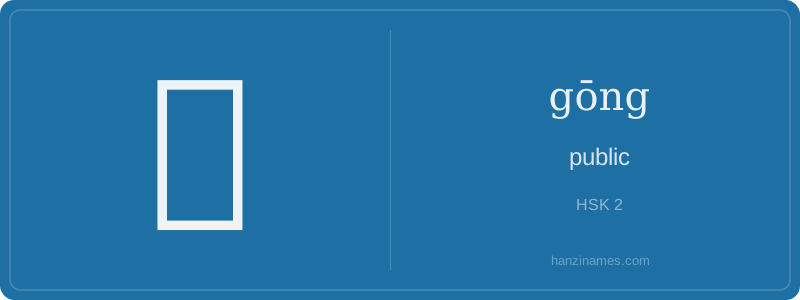
In Beijing’s Chaoyang District, a young teacher uses a public bicycle (共享单车, gòngxiǎng zìxíngchē) to commute past billboards advertising the Public Security Bureau (公安局, gōng'ān jú) and Public Library (公共图书馆, gōnggòng túshūguǎn). This mirrors nationwide usage: 公 appears in over 40% of official administrative terms, including the State Council’s 2023 'Public Data Openness Regulation' (公共数据开放规定). It anchors idioms like 大公无私 (dà gōng wú sī, 'utterly selfless')—a phrase cited in official ethics training since the 1950s.
The character’s earliest attested form appears in bronze inscriptions of the Western Zhou (c. 1046–771 BCE), where 公 depicted a ceremonial vessel held by a noble; later seal script standardized its current shape. Though not a pictograph of 'public,' its association with nobility and impartial authority solidified during Warring States philosophical debates—making it one of China’s oldest semantic markers of collective welfare.
The character 公 (gōng) is a foundational HSK Level 2 character meaning 'public' or 'official', and it appears in countless modern Chinese terms—from public transport to government institutions. Its four-stroke simplicity belies its cultural weight: it embodies ideals of fairness, shared access, and collective responsibility deeply rooted in Confucian-influenced governance traditions.
Historically, 公 denoted noble titles like 'duke' (e.g., Duke of Zhou), evolving over centuries to emphasize impartiality—hence its use in words like 公平 (gōngpíng, 'fairness') and 公正 (gōngzhèng, 'justice'). Unlike characters tied to personal emotion or nature, 公 carries institutional gravity, often signaling authority that serves the people rather than individuals.
In daily life, 公 is ubiquitous yet unobtrusive: on bus stops (公交车), hospital signs (公立医院), and even Wi-Fi networks (公共Wi-Fi). Its radical 八 (bā, 'eight')—though no longer semantically active—reflects ancient graphical simplification; modern learners benefit from recognizing 公 as a stable, high-frequency building block for civic vocabulary.
Example Sentences
Common Compounds
Similar Characters — Don't Mix These Up
Your First Step into Chinese Culture: Get a Chinese Name
Every journey into Chinese begins with a name. Use our free Chinese name generator to create a meaningful, personalized Chinese name that fits you perfectly.
Get My Chinese Name →