共
Character Story & Explanation
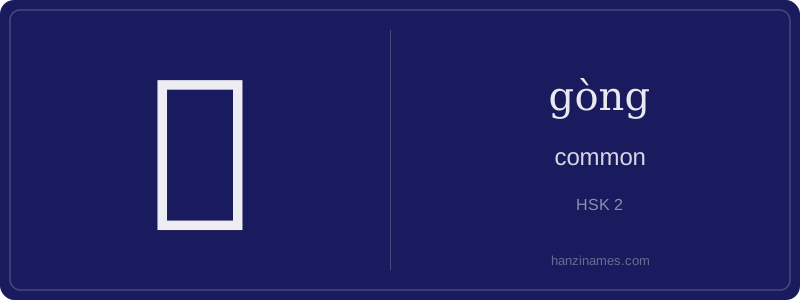
Today, 共 appears ubiquitously in formal and civic contexts: in state media headlines like ‘共建一带一路’ (jointly building the Belt and Road), in classroom posters urging ‘共同进步’ (mutual progress), and in legal documents referencing ‘共有财产’ (jointly owned property). It’s central to HSK 2 vocabulary and appears in the idiom ‘有福同享,有难同当’ (share blessings and hardships alike)—a cornerstone phrase taught in primary schools since the 1950s.
The character’s earliest documented form (late Warring States bamboo slips) shows two facing hands above a container—interpreted by scholars like Qiu Xigui as ‘presenting offerings together’. Though no oracle bone form survives, its bronze inscription variant confirms its origin in ritual collectivity—not abstraction, but embodied cooperation.
Our detective begins at the Shāng dynasty oracle bones—though 共 does not appear there, its earliest confirmed form emerges in Western Zhōu bronze inscriptions (c. 1046–771 BCE) as a symmetrical glyph with two hands () flanking a central element, likely representing shared ritual offerings. This structure signals collective action—not mere sameness, but coordinated participation in sacrifice or governance.
By the Warring States period, the character simplified: the hands merged into the top ‘八’ radical (meaning ‘to separate’ or ‘to divide’), while the lower part evolved into ‘厶’ (sī), originally a pictograph of a wrapped bundle—symbolizing something jointly held or managed. The ‘eight’ radical here doesn’t denote quantity but *distribution*: what is divided among many becomes *common* by virtue of shared access.
The modern form crystallized in the Hàn dynasty’s clerical script, where strokes standardized into six clean movements. Crucially, 共 never meant ‘equal’ in a mathematical sense—it always carried ethical weight: commonality as responsibility. Confucian texts use it to describe shared rites; Legalist documents invoke it for collectively enforced laws—revealing how deeply ‘common’ is tied to duty, not just description.
Example Sentences
Common Compounds
Similar Characters — Don't Mix These Up
Your First Step into Chinese Culture: Get a Chinese Name
Every journey into Chinese begins with a name. Use our free Chinese name generator to create a meaningful, personalized Chinese name that fits you perfectly.
Get My Chinese Name →