准
Character Story & Explanation
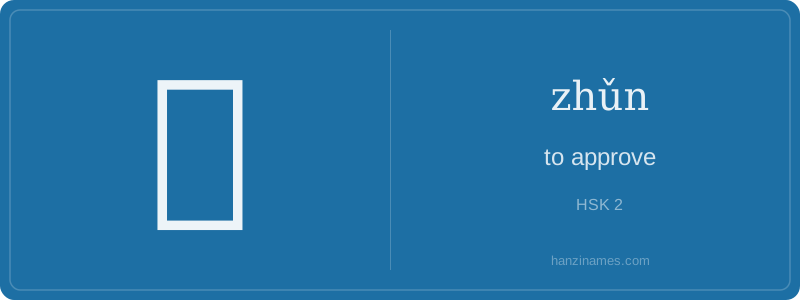
准 is widely used in modern Chinese administration and education: for example, the Ministry of Education publishes annual lists of 'approved universities' (批准高校), and university admission notices state 'you have been approved for enrollment' (你已被准予录取). It appears in the idiom 准备 (zhǔnbèi, 'to prepare') — originally meaning 'to make ready under authorization', now generalized but retaining its root sense of intentional, sanctioned readiness. The character also appears in official documents like 'approval letters' (批准书) and 'entry permits' (准入证).
Historically, 准 first appeared in seal script (c. 3rd century BCE) and evolved from a compound of 冫 (‘ice’, suggesting clarity/standard) and 隹 (zhuī, a short-tailed bird, used phonetically). It was not pictographic but phono-semantic: the sound component 隹 helped indicate pronunciation, while 冫 conveyed the idea of impartial, crystalline judgment — consistent with its use in classical texts like the *Book of Rites* for 'officially sanctioned standards'.
The Chinese character 准 (zhǔn) conveys the core idea of 'to allow', 'to approve', or 'to authorize' — implying formal permission granted by an authority. Unlike English verbs like 'allow', which often carry a passive or permissive tone, 准 emphasizes procedural legitimacy: it’s used when official consent is documented, such as in government approvals, academic admissions, or workplace authorizations. Its radical 冫 (ice) hints at historical associations with clarity, precision, and unambiguous standards — not coldness, but judicial impartiality.
In Western contexts, 'allow' may imply casual tolerance (e.g., 'My parents allow me to stay up late'), whereas 准 almost never appears in informal, personal permissions. Instead, it aligns more closely with bureaucratic equivalents: a visa officer ‘approving’ an application, a university ‘admitting’ a student, or a regulator ‘authorizing’ a medical device. This reflects China’s administrative tradition where written approval (准) carries legal weight and marks a decisive threshold in institutional processes.
Culturally, 准 underscores the value placed on hierarchical validation — something isn’t valid until officially ‘approved’. This contrasts with some Western individualistic norms where autonomy or self-authorization may suffice (e.g., 'I allow myself to rest'). In Chinese usage, 准 signals that external, recognized authority has conferred legitimacy — a concept resonating with Confucian ideals of proper roles and sanctioned action. Thus, 准 isn’t just linguistic; it’s a lexical marker of social order and institutional trust.
Example Sentences
Common Compounds
Similar Characters — Don't Mix These Up
Your First Step into Chinese Culture: Get a Chinese Name
Every journey into Chinese begins with a name. Use our free Chinese name generator to create a meaningful, personalized Chinese name that fits you perfectly.
Get My Chinese Name →