梢
Character Story & Explanation
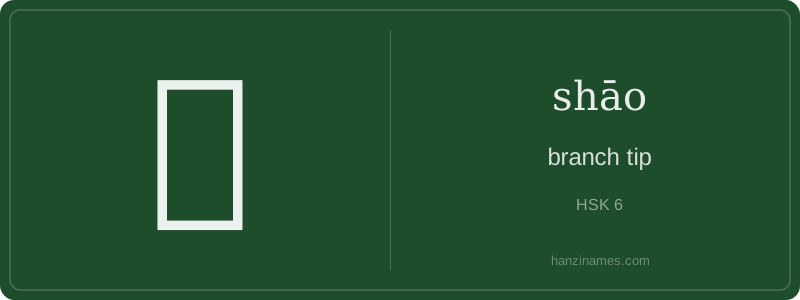
In modern Chinese, 梢 appears most frequently in literary, technical, or regional contexts — especially in forestry, botany, and classical poetry. You’ll find it in official terms like 树梢 (shùshāo, 'treetop') and in idioms like ‘树大招风,梢高易折’ (a tall tree attracts wind; high branches break easily) — a proverb warning against overexposure or arrogance. It’s also used in nautical terms (e.g., 帆梢, fānshāo, 'sail tip') and traditional architecture (e.g., 檐梢, yánshāo, 'eave tip').
The character is not a pictograph but a phono-semantic compound: 木 (semantic, 'wood/tree') + 少 (phonetic, approximating shāo). Its earliest attested forms appear in Han dynasty texts, not oracle bones. Today, Chinese learners encounter it mainly through reading — especially nature descriptions in essays or news about ecological surveys where ‘林梢’ (línshāo, 'forest canopy') is a common term.
Hi students! Let’s learn 梢 (shāo), a Level 6 HSK character with 11 strokes and the 木 (mù, 'tree') radical. It literally means 'the tip or end of a branch' — think of the slender, flexible outermost part of a tree limb, swaying in the wind. This isn’t just botanical vocabulary: 梢 carries poetic weight in classical and modern Chinese, often evoking delicacy, height, or subtle movement.
Notice how the left side 木 tells us it’s related to trees or wood, while the right side 少 (shǎo, 'few, little') hints at 'smallness' or 'end point' — like the 'least' or 'last' part of something long and thin. Though 少 here is primarily phonetic (shāo and shǎo are close in sound), the visual pairing reinforces meaning: a tiny, distant tip on a wooden structure.
Don’t confuse 梢 with similar-sounding characters like 稍 (also shāo) — they share pronunciation but differ in meaning and writing. 梢 is concrete and physical (a branch tip); 稍 is abstract (‘slightly’). Practice writing it stroke by stroke: start with the wood radical, then carefully form 少 — three short strokes first (丿、丨、丶), then the horizontal and dot. Repetition builds muscle memory!
Example Sentences
Common Compounds
Similar Characters — Don't Mix These Up
Your First Step into Chinese Culture: Get a Chinese Name
Every journey into Chinese begins with a name. Use our free Chinese name generator to create a meaningful, personalized Chinese name that fits you perfectly.
Get My Chinese Name →