棕
Character Story & Explanation
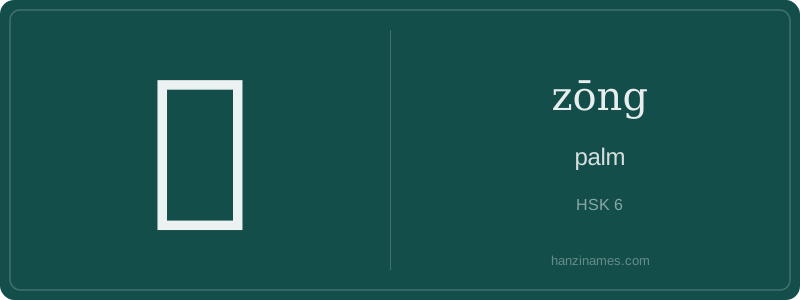
棕 is widely used in modern Chinese for palm-related terms—especially in southern provinces like Guangdong and Hainan, where palm cultivation has been documented since the Tang Dynasty (618–907 CE). It appears in official agricultural reports, product labels (e.g., 棕垫 ‘palm-fiber mat’), and environmental policies promoting sustainable use of 棕榈科 (Arecaceae family) plants. A common phrase is 棕编 (zōngbiān), referring to traditional palm-leaf weaving—a national intangible cultural heritage in Sichuan and Yunnan.
The character is a phono-semantic compound: left side 木 (‘tree’) indicates category; right side 宗 (zōng) provides pronunciation. It first appeared in standardized form in the *Shuōwén Jiězì* (c. 121 CE) as a name for the palm tree, not as a color term—‘brown’ developed later via metonymy from the hue of dried palm fiber. No oracle-bone or bronze inscriptions contain 棕; its earliest verified usage is in Han-era botanical texts.
The Chinese character 棕 (zōng) primarily denotes 'palm'—specifically palm trees and their products—but also carries the secondary meaning of 'brown' due to the color of dried palm fibers. Unlike English, where 'palm' refers both to the hand and the tree, 棕 exclusively relates to the plant: it appears in botanical, agricultural, and craft-related contexts. Its semantic field centers on natural materials—especially coarse, fibrous ones used in traditional Chinese weaving, thatching, and rope-making.
In Western cultures, palms evoke tropical leisure, Mediterranean symbolism (e.g., Palm Sunday), or architectural grandeur (like Egyptian columns). In contrast, 棕 reflects pragmatic utility: historically, palm fiber (棕榈纤维) was vital for brushes, brooms, raincoats, and ship caulking in southern China. There’s no religious or ceremonial association—no Chinese equivalent to ‘palm fronds on Palm Sunday’—making its cultural weight distinctly functional rather than symbolic.
While English speakers might associate ‘palm’ with beaches or victory (e.g., ‘palms of victory’), 棕 is grounded in labor and resilience. Its radical 木 (wood/tree) signals botanical origin, and its right component 宗 (zōng) serves phonetically—not semantically—so it doesn’t imply ‘ancestral’ or ‘sect’ as in other characters using 宗. This reinforces that 棕 is a technical, material-focused term, not a metaphorical or abstract one.
Example Sentences
Common Compounds
Similar Characters — Don't Mix These Up
Your First Step into Chinese Culture: Get a Chinese Name
Every journey into Chinese begins with a name. Use our free Chinese name generator to create a meaningful, personalized Chinese name that fits you perfectly.
Get My Chinese Name →