栋
Character Story & Explanation
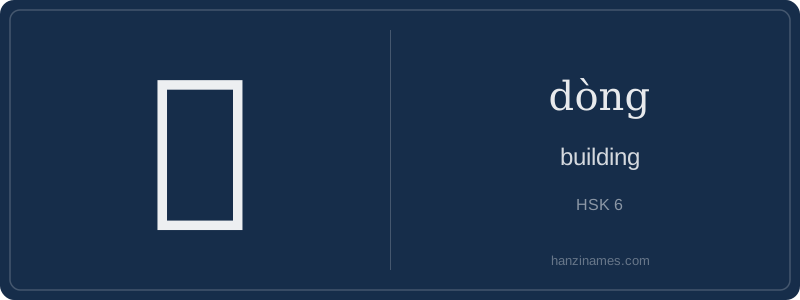
In modern Chinese, 栋 is widely used in real estate listings, government housing reports, and architectural descriptions—for example, the Ministry of Housing and Urban-Rural Development regularly publishes statistics like '全国新建住宅栋数' (national new residential building counts). It appears in fixed terms like 一栋楼 (a building), and in formal expressions such as 栋梁之才 (dòngliáng zhī cái, 'pillar of society'), metaphorically extending its original 'ridgepole' meaning to human excellence.
The character’s form is clearly documented: left side 木 (wood/tree) + right side 东 (dōng, 'east'), which here serves phonetically (dòng sounds close to dōng in ancient pronunciation). It first appeared in seal script during the Qin dynasty (3rd c. BCE) as a semantic-phonetic compound—no oracle-bone origins, but solid archaeological attestation in bronze inscriptions and early dictionaries like the Shuōwén Jiězì (121 CE).
Hi students! Let’s learn 栋 (dòng), a character you’ll see often when talking about buildings in Chinese. It’s not a verb or adjective—it’s a *classifier*, like 'a piece of' or 'a head of', but specifically for houses or large structures. Think of it as 'a building' or 'a structure'—you always use it after a number or demonstrative: 一栋楼 (yī dòng lóu) = 'one building'. It’s formal and literary, common in news, real estate, and official documents—not casual speech.
This character belongs to the 木 (mù, 'tree') radical, which hints at its original meaning: the main ridgepole of a traditional timber-frame house—the central wooden beam supporting the roof. Over time, it evolved from a structural term into a counting word for entire buildings. Though rarely used alone today, it’s essential in compound words and formal writing.
At HSK Level 6, 栋 appears in advanced vocabulary related to architecture, urban development, and policy. Don’t confuse it with measure words like 座 (zuò) or 幢 (zhuàng)—栋 emphasizes solidity, grandeur, and permanence. Practice it in phrases like 一栋别墅 (yī dòng biéshù, 'a villa') or 三栋教学楼 (sān dòng jiàoxué lóu, 'three teaching buildings'). Writing it correctly matters: 9 strokes, starting with the 木 radical on the left!
Example Sentences
Common Compounds
Similar Characters — Don't Mix These Up
Your First Step into Chinese Culture: Get a Chinese Name
Every journey into Chinese begins with a name. Use our free Chinese name generator to create a meaningful, personalized Chinese name that fits you perfectly.
Get My Chinese Name →