椎
Character Story & Explanation
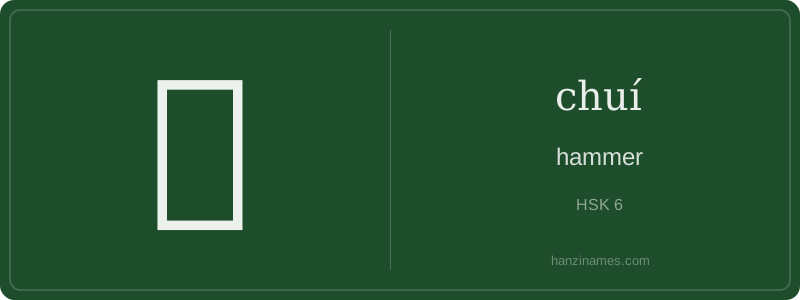
In modern usage, 椎 appears most frequently in medical terminology — especially in compound 脊椎 (jǐzhuī, 'vertebra/spine') — where it’s pronounced zhuī. This usage dominates hospitals, textbooks, and public health campaigns across China. It also survives in literary idioms like 椎心泣血 (chuí xīn qì xuè, 'to strike one’s heart and weep blood'), a classical expression of profound grief documented in Han dynasty texts such as the *Shuoyuan*. The phrase remains in formal writing and news headlines reporting national tragedies.
The character’s form has no verified oracle-bone origin. Its earliest secure attestation is in Warring States bamboo slips (4th c. BCE), where it consistently combines 木 (wood) and 垂 (to hang/descend) — reflecting its function as a heavy, downward-striking tool. Today, Chinese speakers encounter 椎 daily on MRI reports, physical therapy posters, or even in martial arts manuals describing strikes to the spine.
Our detective begins at the crime scene: the character 椎. At first glance, it appears to be a simple ‘wood’ (木) radical paired with ‘zhuī’ (隹) — but wait! That’s a red herring. The right-hand component is actually 垂 (chuí), meaning ‘to hang down’, not 隹. This visual misdirection has tripped up learners for centuries. Early seal script forms (c. 3rd century BCE) show 木 clearly anchoring the left, while the right hand evolved from a stylized depiction of something heavy descending — reinforcing its core sense of impact and downward force.
Why two pronunciations? Historical phonology holds the key. In Middle Chinese (c. 7th–10th c. CE), 椎 belonged to the *ch-* initial group with a rising tone — yielding modern chuí in literary contexts (e.g., 椎心泣血). But in colloquial compounds like 脊椎 (jǐzhuī, 'spine'), the reading shifted to zhuī due to morphological leveling and phonetic erosion — a documented sound change attested in rhyme dictionaries like the *Guangyun*. This duality isn’t error; it’s linguistic archaeology.
The radical 木 (wood) is no coincidence: early hammers and mallets were wooden tools — think of the ritual *chuí* used in Zhou dynasty bronze inscriptions to pound ceremonial vessels or shape lacquerware. Even today, 椎 retains this material logic: whether striking metal (in forging) or compressing earth (in construction), its semantic heart remains *a heavy wooden instrument delivering controlled force*. It’s not just ‘hammer’ — it’s *the wooden implement of impact*.
Example Sentences
Common Compounds
Similar Characters — Don't Mix These Up
Your First Step into Chinese Culture: Get a Chinese Name
Every journey into Chinese begins with a name. Use our free Chinese name generator to create a meaningful, personalized Chinese name that fits you perfectly.
Get My Chinese Name →