欺
Character Story & Explanation
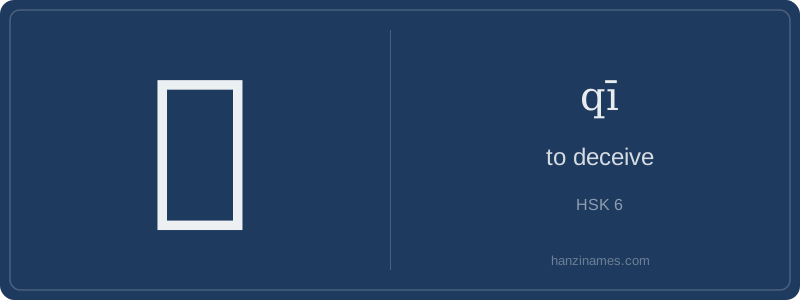
In modern Chinese, 欺 is central to legal, ethical, and digital contexts: 'online fraud' (网络诈骗) and 'consumer deception' (消费欺诈) are regulated under laws explicitly using 欺. It appears in the idiom 欺上瞒下 (qī shàng mán xià, 'deceive superiors and conceal from subordinates'), documented since the Ming dynasty in official records criticizing bureaucratic corruption. The term 欺诈 (qīzhà, 'fraud') appears over 12,000 times in China’s Supreme People’s Court judicial database (2023 annual report).
The character’s form has no pictographic origin—it’s a standardized semantic-phonetic compound. Its left part 其 was borrowed for pronunciation; its right part 欠 (originally depicting a person yawning or opening mouth) signals oral/performative action. Today, Chinese speakers instantly recognize 欺 in headlines like '商家欺客' (shāngjiā qī kè, 'merchants cheat customers')—a frequent consumer rights complaint on platforms like Xiaohongshu and the 12315 government hotline.
As a linguistic detective, I begin with the radical: 欠 (qiàn), meaning 'to lack' or 'to yawn'—a component often linked to mouth-related actions and insufficiency. In 欺, it forms the right-hand frame, suggesting an action emerging from speech or breath—fitting for deception, which relies on words. The left side, 其 (qí), is a phonetic loan character originally meaning 'basket' in oracle bone script but repurposed here purely for sound. This classic 'semantic-phonetic' structure (形声字) reveals ancient scribes’ pragmatic logic: borrow a known sound, attach a meaningful radical.
The character first appears reliably in Warring States bamboo texts and the *Shuōwén Jiězì* (121 CE), where Xu Shen defines it as ‘to cheat or deceive by taking advantage of another’s weakness’. Notably, 欠 does not depict deception literally—but signals vocal or performative behavior, reinforcing that 欺 is fundamentally *speech-act-based* unfairness: lying, bluffing, or exploiting trust through language. Its 12 strokes encode this duality: precision in form, ambiguity in intent.
Unlike pictographic characters, 欺 evolved not from a visual metaphor but from grammatical necessity—as Chinese society formalized ethics and law. By the Han dynasty, it appeared in legal statutes condemning fraud and in Confucian critiques of hypocrisy. The character’s stability across 2,000 years reflects how deeply Chinese thought associates injustice with *verbal violation*: not just stealing goods, but stealing truth, consent, or fairness through misrepresentation. Its HSK 6 status confirms its role in advanced discourse—debates on ethics, law, media literacy, and social trust.
Example Sentences
Common Compounds
Similar Characters — Don't Mix These Up
Your First Step into Chinese Culture: Get a Chinese Name
Every journey into Chinese begins with a name. Use our free Chinese name generator to create a meaningful, personalized Chinese name that fits you perfectly.
Get My Chinese Name →