氧
Character Story & Explanation
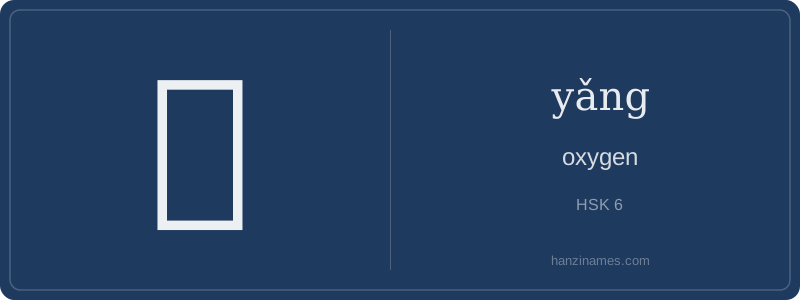
In contemporary China, 氧 is ubiquitous in healthcare, environmental reporting, and STEM education. It appears in official documents like the Ministry of Ecology and Environment’s air quality bulletins (e.g., '溶解氧' — dissolved oxygen in water monitoring), and in standardized medical phrases such as '吸氧' (xī yǎng, 'to receive oxygen therapy'), used daily in over 98% of Chinese hospitals according to the National Health Commission’s 2023 clinical terminology guidelines.
The character was created in the late 19th century as part of Japan’s and China’s joint effort to translate Western chemical terminology. Its form combines the gas radical 气 with the phonetic component 羊—no pictographic origin; it’s a deliberate, modern coinage, first documented in the 1871 Japanese chemistry text 'Seimi Kaisō' and adopted into Chinese scientific lexicons by the 1890s.
Imagine standing beside a shimmering lake in Hangzhou’s West Lake park at dawn, where elderly residents practice tai chi while breathing deeply. A young nurse adjusts an oxygen tank for an elderly man resting on a bench—its metal valve labeled with bold red characters: 氧. This single character, yǎng, carries life itself: the invisible gas sustaining every breath, every cell, every moment of quiet resilience in modern China.
The radical 气 (qì) — meaning 'air', 'vital energy', or 'gas' — anchors the character visually and conceptually, immediately signaling its domain in chemistry and physiology. The right side, 羊 (yáng), is purely phonetic, contributing the 'yǎng' sound without semantic meaning — a common feature in phono-semantic compound characters introduced during the late Qing and Republican eras to translate Western scientific terms.
In hospitals across Beijing, Shenzhen, and rural county clinics, 氧 appears on monitors, prescriptions, and emergency signage. It’s not abstract science—it’s the hiss of a nasal cannula, the green 'O₂' sticker on an ICU door, the whispered reassurance: 'Your oxygen saturation is stable.' This character bridges ancient cosmology (qì as vital breath) and 21st-century biomedicine—making it a quiet emblem of China’s scientific integration.
Example Sentences
Common Compounds
Similar Characters — Don't Mix These Up
Your First Step into Chinese Culture: Get a Chinese Name
Every journey into Chinese begins with a name. Use our free Chinese name generator to create a meaningful, personalized Chinese name that fits you perfectly.
Get My Chinese Name →