汰
Character Story & Explanation
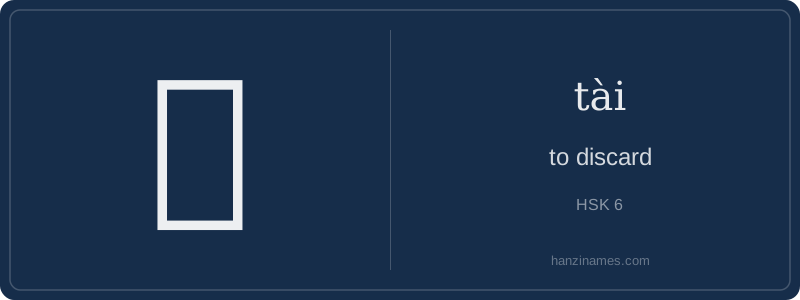
汰 appears frequently in formal and administrative contexts, especially in the compound 淘汰 (tàotài), meaning 'to eliminate through competition' or 'to phase out'. It’s used in official documents, corporate HR policies, and education reform reports—for example, China’s Ministry of Education has referenced 淘汰 outdated curricula in policy white papers since the 2010s. The phrase 淘汰赛 (tàotàisài, 'knockout tournament') is ubiquitous in sports reporting and school competitions.
汰 is a late-developing character: it does not appear in oracle bone or bronze inscriptions. Its earliest verified attestation is in the Han dynasty text *Shuowen Jiezi* (c. 100 CE), where it is defined as ‘removing dregs with water’ (以水淅米曰汰). Its structure—氵 (water) + 太 (tài, ‘excessive’, ‘supreme’)—reflects its semantic logic: using water to remove what is excessive or inferior, leaving only the optimal core.
The character 汰 (tài) embodies a quiet but profound aspect of the Chinese worldview: discernment through refinement. Unlike blunt rejection, 汰 implies a selective, water-assisted process—like rinsing rice to remove husks or filtering impurities from a stream. This reflects a cultural preference for gradual, harmonious improvement rather than total eradication. It suggests that value lies not in wholesale removal, but in careful sifting—preserving essence while releasing what no longer serves.
In classical thought, water (氵) is associated with wisdom, adaptability, and natural purification. 汤 (tāng, ‘soup’) and 洗 (xǐ, ‘to wash’) share this radical, reinforcing the idea that cleansing is relational and contextual. 汰 thus carries philosophical weight: discarding is not failure, but maturity—a sign of clarity, discipline, and alignment with Daoist and Confucian ideals of cultivated judgment.
Modern usage extends this ethos into institutions and self-cultivation. Companies ‘淘汰’ (tàotài) underperforming staff not as punishment, but as systemic renewal; students ‘淘汰’ outdated study methods to embrace better ones. The character subtly challenges Western binaries of success/failure by framing discard as an ethical, almost ritual act—rooted in care, not contempt. To use 汰 is to participate in a centuries-old rhythm of renewal grounded in respect for process.
Example Sentences
Common Compounds
Similar Characters — Don't Mix These Up
Your First Step into Chinese Culture: Get a Chinese Name
Every journey into Chinese begins with a name. Use our free Chinese name generator to create a meaningful, personalized Chinese name that fits you perfectly.
Get My Chinese Name →