沃
Character Story & Explanation
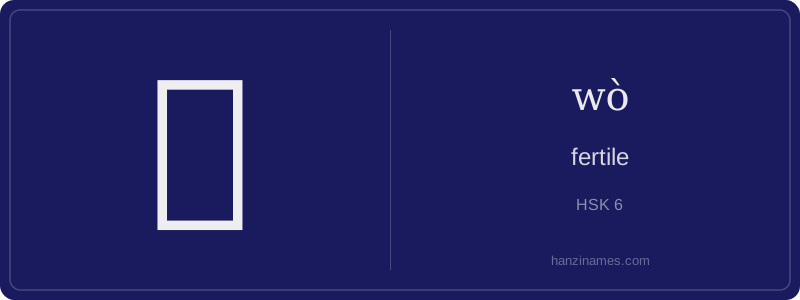
沃 appears frequently in modern Chinese geographical terminology and official documents—especially in phrases like 沃土 (wòtǔ, 'fertile soil') and 沃野 (wòyě, 'fertile plain'), both used in state media, agricultural reports, and textbooks to describe ecologically productive regions such as the Northeast Plain or Sichuan Basin. It also features in the idiom 沃野千里 (wòyě qiānlǐ), meaning 'a thousand li of fertile land', a phrase dating back to the Han dynasty’s *Records of the Grand Historian*, praising regions vital for grain production and military supply.
The character’s form is well-documented: 沃 is a phono-semantic compound. The left radical 氵 (water) indicates its association with moisture and irrigation; the right component 夭 (yāo, originally depicting a person dancing or bending, later phonetic) provides pronunciation and hints at vitality. No oracle-bone or bronze script forms survive, but its earliest attestation is in Warring States bamboo texts, consistently used for rich, irrigated land—never metaphorically for people or ideas.
The Chinese character 沃 (wò) conveys the idea of fertility—specifically, land enriched by water and nutrients, capable of abundant growth. Unlike English 'fertile', which often applies broadly (e.g., fertile mind, fertile soil), 沃 is almost exclusively agronomic and geographical: it describes naturally rich, well-watered soil or regions, especially in classical and formal contexts. Its semantic core lies in the interplay of water (氵) and abundance—not mere productivity, but life-sustaining richness rooted in hydrological balance.
In traditional Chinese cosmology, fertility wasn’t just biological—it reflected harmony between heaven (rain), earth (soil), and human stewardship. 沃 embodies this triad: the water radical (氵) signals irrigation or natural moisture; the right component (夭) historically suggested vigorous, upward growth. Thus, 沃 implies *sustained* fertility—resilient, irrigated, and generative—not temporary yield. This contrasts with Western notions where fertility can be technologically boosted (e.g., synthetic fertilizers), whereas 沃 evokes intrinsic, ecological richness.
Western equivalents like 'arable', 'lush', or 'verdant' capture aspects but miss 沃’s cultural weight. 'Arable' emphasizes cultivability, not inherent richness; 'lush' stresses visual density, not soil quality. The closest cultural parallel may be the Roman concept of *ager fertilis*—land blessed by gods and rivers—but even that lacks 沃’s lexical precision and enduring bureaucratic usage in Chinese land surveys and historical texts. 沃 remains a quiet yet authoritative term in policy, geography, and literature, signifying land worthy of inheritance and reverence.
Example Sentences
Common Compounds
Similar Characters — Don't Mix These Up
Your First Step into Chinese Culture: Get a Chinese Name
Every journey into Chinese begins with a name. Use our free Chinese name generator to create a meaningful, personalized Chinese name that fits you perfectly.
Get My Chinese Name →