沼
Character Story & Explanation
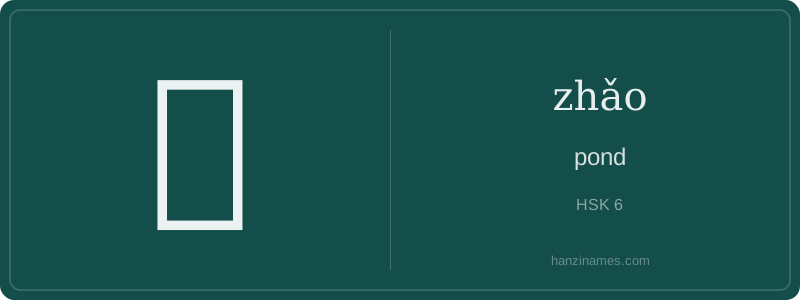
In modern Chinese, 沼 appears most frequently in compound words like 沼泽 (zhǎozé, 'marsh') and 沼气 (zhǎoqì, 'biogas'), reflecting its practical role in ecology and rural energy systems. It rarely stands alone in daily speech—unlike 湖 (hú, 'lake') or 河 (hé, 'river')—but appears in scientific, environmental, and literary contexts. The phrase 草木沼泽 (cǎomù zhǎozé, 'herbaceous marsh') is used in official wetland classification documents by China’s Ministry of Natural Resources.
The character’s form is not pictographic but phono-semantic: the left radical 氵 ('water') signals semantic category, while the right component 召 (zhào) provides approximate phonetic guidance. Though 召 itself means 'to summon', this is coincidental—the sound match is historical, not conceptual. In daily life, Chinese learners encounter 沼 primarily in HSK 6 reading passages about environmental policy or classical poetry anthologies.
At first glance, 沼 (zhǎo) means 'pond'—but in the Chinese worldview, water is never neutral. A pond is not merely a body of still water; it is a threshold between vitality and stagnation, clarity and concealment. Traditional cosmology sees water as yin: receptive, reflective, and deeply connected to the unseen—spirit, memory, and hidden forces. Thus 沼 evokes quiet depth, not emptiness—a place where lotus roots anchor in mud while blossoms rise pure into sunlight.
This duality shapes its cultural resonance: in classical poetry, 沼 often appears in pastoral or melancholic settings—think of Du Fu’s lines describing abandoned imperial ponds, where still water mirrors fallen glory. Unlike the dynamic river (河) or vast sea (海), 沼 suggests intimacy, containment, and subtle power—water that gathers, waits, and transforms slowly beneath the surface, echoing Daoist reverence for the unassuming and enduring.
Even today, 沼 carries ecological weight. With China’s wetland conservation efforts and the 2021 national Wetland Protection Law, 沼 has re-entered public discourse—not as relic, but as ecological unit. Its presence in terms like 沼泽 (marsh) signals awareness of fragile, life-sustaining interfaces between land and water. To write 沼 is to acknowledge that stillness can be strategic, that small bodies of water hold outsized roles in balance, biodiversity, and cultural memory—quietly shaping landscapes and literatures alike.
Example Sentences
Common Compounds
Similar Characters — Don't Mix These Up
Your First Step into Chinese Culture: Get a Chinese Name
Every journey into Chinese begins with a name. Use our free Chinese name generator to create a meaningful, personalized Chinese name that fits you perfectly.
Get My Chinese Name →