沾
Character Story & Explanation
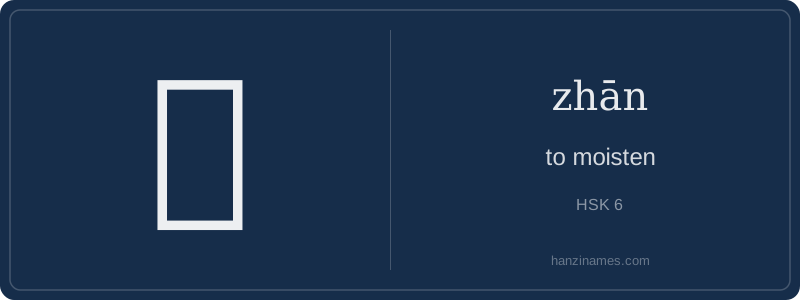
沾 is commonly used in daily Mandarin in contexts ranging from cooking ('Don’t let the dumpling wrapper 沾 too much water') to idioms like 沾沾自喜 (zhān zhān zì xǐ, 'smugly pleased with oneself'), documented since at least the Qing dynasty in texts like *The Scholars* (1750). It frequently appears in culinary instructions, skincare product labels ('non-sticky, won’t 沾 hands'), and classical poetry describing dew or mist.
The character’s form is a semantic-phonetic compound: left side 氵 (water radical) signals meaning; right side 占 (zhān, 'to occupy') provides pronunciation and hints at 'adhering/occupying space'. No oracle-bone or bronze script forms survive for 沾—it first appears reliably in clerical script (Lìshū) during the Han dynasty, reflecting its later emergence as a specialized term for light wetting.
The character 沾 (zhān) conveys the gentle, physical action of moisture adhering to a surface—like dew settling on grass or ink slightly bleeding into paper. Unlike English verbs such as 'soak' or 'drench', which imply saturation, 沾 emphasizes light, transient contact: a fingertip brushing water, steam condensing on glass, or perfume lingering on fabric. Its nuance lies in minimalism and intentionality—not full immersion, but meaningful touch.
In Chinese linguistic culture, 沾 often carries subtle connotations beyond physics: it appears in expressions implying indirect influence or incidental benefit, like 沾光 (zhān guāng, 'to bask in someone’s glory'). This reflects a worldview where connection—even slight, passive contact—can confer value, echoing Confucian ideals of relational reciprocity and social resonance.
Western equivalents rarely capture this duality. English ‘moisten’ is purely descriptive and neutral; ‘touch’ lacks the aqueous element; ‘benefit from’ loses the sensory imagery. German ‘benetzen’ or French ‘humecter’ are technical and clinical. 沾 uniquely bridges tactile experience and social metaphor—a quiet verb with cultural weight, fitting its HSK 6 status as a lexical bridge between concrete action and abstract implication.
Example Sentences
Common Compounds
Similar Characters — Don't Mix These Up
Your First Step into Chinese Culture: Get a Chinese Name
Every journey into Chinese begins with a name. Use our free Chinese name generator to create a meaningful, personalized Chinese name that fits you perfectly.
Get My Chinese Name →