洪
Character Story & Explanation
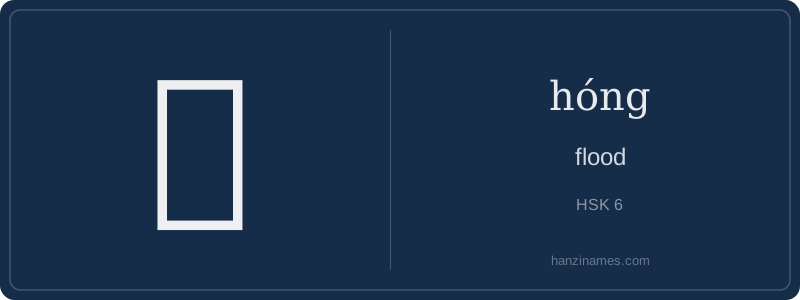
洪 is widely used in modern Chinese for natural disasters (e.g., 洪水 hóngshuǐ ‘flood’, 洪灾 hóngzāi ‘flood disaster’) and appears in official terminology from China’s Ministry of Emergency Management and CCTV weather reports. It features prominently in idioms like 洪福齐天 (hóng fú qí tiān, ‘blessings as vast as heaven’)—a phrase historically used in imperial edicts and still heard at weddings and New Year celebrations. The character also appears in proper nouns like Hong Kong (香港 Xiānggǎng, literally ‘Fragrant Harbor’), where 洪 is unrelated phonetically but shares the water radical, subtly reinforcing regional ties to maritime geography.
Archaeologically, 洪 first appears in bronze inscriptions of the Western Zhou (c. 1046–771 BCE) as a variant of 共 + 氵, indicating ‘abundant water’. Its modern form stabilized during the Han dynasty. Unlike pictographic characters (e.g., 日 ‘sun’), 洪 is semantic-phonetic: 氵 (water) signals meaning, while 共 (gòng) provides phonetic approximation—though pronunciation diverged over time. No oracle-bone form is confirmed; earliest attested use is in ritual bronze texts describing river control efforts.
The character 洪 (hóng) embodies more than water in motion—it reflects the Chinese worldview where natural forces are neither purely destructive nor benevolent, but deeply relational. In classical thought, floods were seen as cosmic signals: imbalance in human conduct (e.g., corrupt governance or ecological neglect) could provoke Heaven’s response through overflowing rivers. This aligns with the Confucian ideal of harmony between humanity and nature (天人合一), where water—especially the ‘great flood’—serves as both warning and catalyst for moral renewal.
Historically, the Great Flood myth centered on Yu the Great (大禹) is foundational to Chinese statecraft. Unlike mythic heroes who battle floods with force, Yu succeeded by *channeling* water—digging canals, redirecting flow, working *with* nature’s logic. This shaped a cultural preference for adaptive resilience over domination, visible in modern water management policies and metaphors for leadership: true strength lies in guiding, not suppressing.
Even today, 洪 carries layered resonance: it names literal disasters (洪灾), but also signifies abundance (洪福—‘vast fortune’) and magnitude (洪亮—‘resounding’). This duality reveals a core linguistic philosophy—characters often encode complementary opposites. Water’s capacity to destroy *and* nourish mirrors yin-yang interdependence, teaching that power, like floodwaters, gains meaning only through context, restraint, and purposeful direction.
Example Sentences
Common Compounds
Similar Characters — Don't Mix These Up
Your First Step into Chinese Culture: Get a Chinese Name
Every journey into Chinese begins with a name. Use our free Chinese name generator to create a meaningful, personalized Chinese name that fits you perfectly.
Get My Chinese Name →