汹
Character Story & Explanation
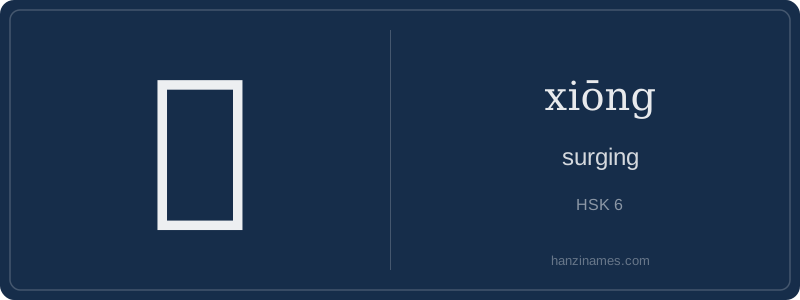
汹 is most commonly encountered in the compound 汹涌 (xiōngyǒng), meaning 'surging' or 'roiling', used across media, literature, and daily speech—e.g., in news reports about '汹涌的人潮' (surging crowds during Spring Festival travel) or '情绪汹涌' (emotions surging). It appears in the 2023 HSK 6 vocabulary list and frequently in formal writing to convey intensity without moral judgment. Historically, it appears in Tang dynasty poetry and Ming-Qing vernacular novels describing turbulent waters and mass movements.
The character is not pictographic in origin; it evolved from seal script forms combining 氵 (water) and 凶 (xiōng, meaning 'inauspicious' or 'fierce'), which here functions phonetically and semantically—suggesting danger *through* force, not malice. Today, Chinese learners encounter it first in weather reports ('海面汹涌') or protest coverage ('舆论汹涌'), always tied to visible, collective motion.
The character 汹 (xiōng) embodies the Chinese worldview’s deep attunement to nature’s overwhelming, dynamic forces—not as chaos to be tamed, but as a rhythmic, awe-inspiring power demanding respect and alignment. Its water radical (氵) grounds it in the Daoist reverence for water as the softest yet most unstoppable force—yielding, persistent, and ultimately transformative. This reflects a cultural sensibility where intensity is not inherently negative; rather, it signals vitality, momentum, or collective energy that must be channeled wisely.
In classical and modern usage, 汹 conveys a surge that is both physical and metaphorical: rivers in flood, public sentiment rising like tide, or ideas spreading with irresistible velocity. Unlike Western binaries of control vs. disorder, 汹 suggests an ethical imperative—to observe the swell, understand its source, and respond with timely harmony, not suppression. It appears in texts from the *Huainanzi* to contemporary news headlines, always marking a threshold moment before transformation.
This character reveals how Chinese language encodes ecological and social philosophy in a single glyph. The three-dot water radical isn’t decorative—it’s ontological: meaning arises *from* flow, not against it. When Chinese speakers say ‘汹涌’, they don’t just describe waves—they invoke a worldview where human affairs are inseparable from natural cycles, where even political unrest or market volatility is linguistically framed as a tidal phenomenon—temporary, powerful, and part of a larger pattern of ebb and flow.
Example Sentences
Common Compounds
Similar Characters — Don't Mix These Up
Your First Step into Chinese Culture: Get a Chinese Name
Every journey into Chinese begins with a name. Use our free Chinese name generator to create a meaningful, personalized Chinese name that fits you perfectly.
Get My Chinese Name →