洽
Character Story & Explanation
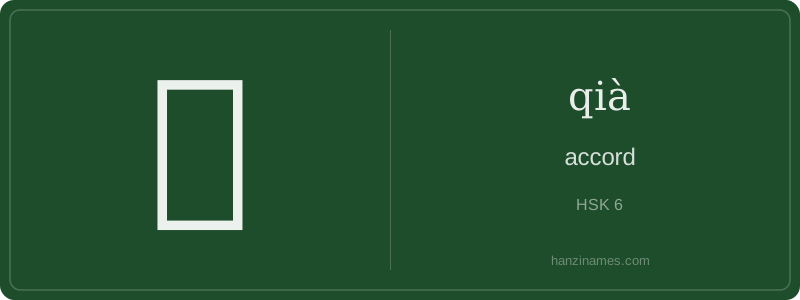
洽 is widely used in modern Chinese in formal and professional settings—especially in diplomacy, business negotiations, and interpersonal relationships. Common phrases include 洽谈 (qiàtán, 'to hold consultative talks') and 融洽 (róngqià, 'harmonious, cordial'), both appearing regularly in official media like Xinhua News Agency and government white papers. The idiom 洽闻强记 (qià wén qiáng jì), meaning 'well-informed and retentive', appears in classical texts like the Book of Han, attesting to its long-standing use for intellectual compatibility.
The character 洽 is a phono-semantic compound: the left radical 氵 ('water') suggests fluidity and smoothness; the right component 甲 (jiǎ, originally meaning 'first in order' or 'armor') serves as a phonetic clue (though pronunciation has shifted). Its earliest verified form appears in seal script (c. 3rd century BCE), with no pictographic origin—it evolved structurally, not visually, reflecting conceptual abstraction rather than concrete imagery.
The Chinese character 洽 (qià) conveys a nuanced sense of 'accord'—not merely agreement, but harmonious, mutual understanding achieved through open communication and shared goodwill. Unlike English ‘agreement’, which can be contractual or superficial, 洽 implies relational resonance: smooth interaction, compatibility in temperament or purpose, and effortless coordination. It’s often used in formal, diplomatic, or professional contexts where trust and alignment matter more than mere consent.
In Western cultural frameworks, the closest equivalents are concepts like ‘rapport’ (psychology), ‘concord’ (political philosophy), or ‘chemistry’ (interpersonal dynamics)—but none fully capture 洽’s emphasis on *processual harmony*: it describes the state *after* successful dialogue, not just the outcome. Think of a U.S. labor negotiation reaching ‘a meeting of the minds’, or a German consensus-based decision in a Stadtverordnetenversammlung—both reflect aspects of 洽, yet lack its linguistic centrality to relational fluency.
Culturally, 洽 resonates with Confucian ideals of 和 (harmony) and 信 (trustworthiness), where accord arises from sincerity and reciprocity—not power or compromise. This distinguishes it from Western notions rooted in individual rights or adversarial negotiation (e.g., ‘win-win’). In practice, 洽 is rarely used alone; it thrives in compounds like 融洽 (róngqià, ‘warm rapport’) or 洽谈 (qiàtán, ‘consultative talks’), underscoring that accord is relational, dynamic, and cultivated—not static or imposed.
Example Sentences
Common Compounds
Similar Characters — Don't Mix These Up
Your First Step into Chinese Culture: Get a Chinese Name
Every journey into Chinese begins with a name. Use our free Chinese name generator to create a meaningful, personalized Chinese name that fits you perfectly.
Get My Chinese Name →