务
Character Story & Explanation
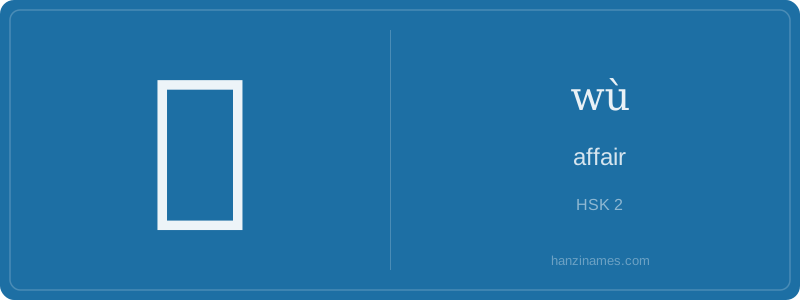
务 is widely used in modern Chinese administrative, educational, and professional language. It appears in official terms like ‘政务’ (zhèngwù, ‘government affairs’) and common imperatives like ‘务必’ (wùbì, ‘must absolutely’). A well-documented phrase is ‘实事求是,务求实效’ (seek truth from facts and pursue practical results), a slogan promoted since the 1980s in Party documents and school textbooks. It’s also central in the HSK curriculum as a foundational character for expressing responsibility and purpose.
The character 务 evolved from seal script, where it combined 夂 (indicating movement toward a task) and 務 (an older variant with 夕 + 力). By the Han dynasty, it standardized into its current form — not a pictograph, but a semantic-phonetic compound. Today, Chinese people use it daily in phrases like ‘工作任务’ (work assignment) or ‘务农’ (engage in farming), reflecting real-life roles and commitments.
Hi students! The character 务 (wù) is a Level 2 HSK word — essential for everyday communication. It’s pronounced with the fourth tone, like a firm, falling pitch: wù. At its core, 务 means 'affair', 'matter', or 'task' — something that requires attention or action. Though simple in form (just 5 strokes), it carries weight in both formal and practical contexts, from work duties to national responsibilities.
This character often appears as part of compound words rather than alone. You’ll rarely see it by itself in modern speech — instead, it teams up with other characters to express purpose, obligation, or function (e.g., 服务 'to serve', 务必 'must'). Its radical 夂 (zhǐ) hints at movement toward something — historically linked to 'going to attend to matters', reinforcing its sense of duty or engagement.
Don’t confuse 务 with similar-looking characters like 功 (gōng, 'achievement') or 物 (wù, 'thing') — though they share pronunciation, their meanings and radicals differ sharply. Practice writing 务 stroke-by-stroke: start with the top dot (丶), then the horizontal stroke (一), followed by the left-falling stroke (丿), then the right-falling stroke (丶), and finish with the distinctive 'walking' radical 夂. Repetition builds muscle memory!
Example Sentences
Common Compounds
Similar Characters — Don't Mix These Up
Your First Step into Chinese Culture: Get a Chinese Name
Every journey into Chinese begins with a name. Use our free Chinese name generator to create a meaningful, personalized Chinese name that fits you perfectly.
Get My Chinese Name →