千
Character Story & Explanation
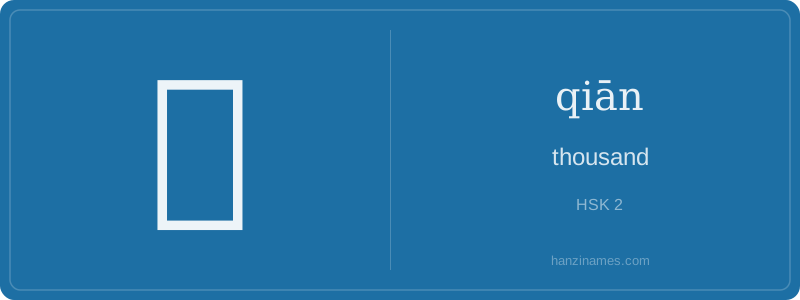
In daily life, 千 appears ubiquitously: prices (¥999), population statistics (千人), digital slang (千粉 ‘a thousand followers’ on Weibo), and formal documents (‘in the past thousand years’). It anchors idioms like 一落千丈 (yī luò qiān zhàng, ‘to plummet a thousand zhang’) and 万紫千红 (wàn zǐ qiān hóng, ‘ten thousand purples, a thousand reds’—a phrase from Song dynasty poetry describing spring’s splendor).
The character evolved from seal script where 千 resembled 十 (shí, ‘ten’) with an added horizontal stroke above—symbolizing ‘ten times one hundred’. No oracle bone form survives; its earliest attested shape is in late Western Zhou bronze inscriptions (~9th c. BCE), consistently used as a multiplicative numeral, not a pictograph.
As an archaeologist brushing dust from a Warring States bamboo slip, I find 千 etched with startling consistency—not as a pictograph of counting rods or tally marks, but as a deliberate simplification of the numeral 'ten' (十) extended upward, signaling multiplication by one hundred. Early forms in bronze inscriptions show it already detached from concrete imagery, functioning abstractly as a scalar marker long before standardized script.
This character reveals how ancient Chinese quantification prioritized relational magnitude over visual representation: 千 isn’t ‘a picture of a thousand things’—it’s the conceptual leap from ten (十) to ‘ten tens’ (百) to ‘ten hundreds’ (千), codified in three clean strokes. Its minimalism reflects bureaucratic efficiency: scribes needed rapid, unambiguous notation for taxes, grain stores, and troop musters across vast territories.
Crucially, 千 never stood alone as a standalone concept in early texts—it always modified nouns or paired with measure words (e.g., 千乘 ‘thousand chariots’). This syntactic dependency tells us that ancient Chinese numeracy was inherently contextual, embedding quantity within social and material reality—not abstract mathematics. Its endurance across 2,500 years speaks to the power of functional clarity over ornamental form.
Example Sentences
Common Compounds
Similar Characters — Don't Mix These Up
Your First Step into Chinese Culture: Get a Chinese Name
Every journey into Chinese begins with a name. Use our free Chinese name generator to create a meaningful, personalized Chinese name that fits you perfectly.
Get My Chinese Name →