右
Character Story & Explanation
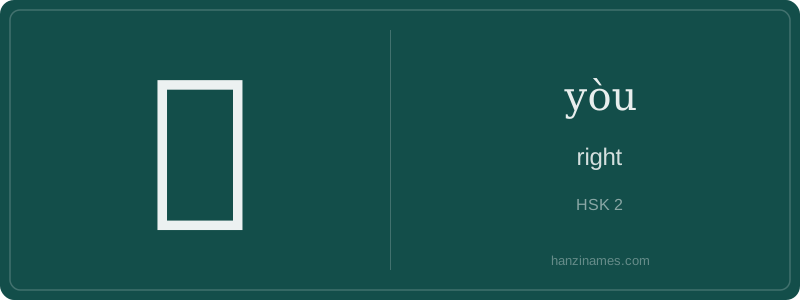
In daily life, 右 appears ubiquitously: on street signs (‘右转’ — 'turn right'), keyboard shortcuts (Ctrl+Right Arrow), and subway maps indicating platform sides. Historically, it carried profound weight: Confucian ritual texts mandated that honored guests sit to the host’s right, and in Tang-era civil service exams, top scorers were seated on the right side of the examination hall. The idiom ‘左右逢源’ (zuǒ yòu féng yuán)—literally 'meet sources on both left and right'—means 'to be resourceful and successful everywhere', reflecting the balanced authority associated with both directions.
The character’s form has no verified pictographic origin. Early bronze inscriptions show 右 as a stylized combination of 又 (a hand) and 口—yet by the Warring States period, 口 became dominant and 又 faded. Modern scholarship treats it as a phonetic loan: the shape evolved for sound, not image. Today, Chinese learners first encounter it in traffic signs and directional instructions—making 'right turn' its most frequent real-world context.
As a detective tracing 右’s evolution, I begin with its earliest secure appearance in bronze inscriptions of the Western Zhou (c. 1046–771 BCE), where it already resembles the modern form—five strokes, no pictographic resemblance to a hand or direction. Unlike many directional characters, 右 wasn’t originally a picture of a right hand; instead, it emerged as a phonosemantic compound, with 口 (mouth) as a purely phonetic component—a surprising twist, since 口 has no semantic link to 'right'. Linguists note that early forms sometimes included a hand radical (又) beneath 口, but this variant disappeared by the Qin dynasty.
The character’s semantic core stabilized early: in classical texts like the *Zuo Zhuan*, 右 consistently denotes the right side in spatial, ritual, and political contexts—e.g., ‘standing on the right’ of a ruler signified high honor. Its association with prestige is ancient: in Zhou court protocol, the right position was reserved for the most trusted minister, while the left was secondary. This hierarchy persisted into imperial examinations and temple architecture, where deities were often placed to the right of the central figure to indicate rank.
Modern standardization cemented 右’s current shape during the Han dynasty’s clerical script reforms—streamlining earlier seal-script variants. Crucially, 口 never meant 'mouth' here; it served only to hint at pronunciation (*yòu* rhymes with archaic words written with 口, like 又 *yòu*). This phonetic borrowing explains why 右 shares its sound with 又 ('again') and 佑 ('to protect'), forming a small homophone family. The radical assignment to 口 in dictionaries is thus a lexicographic convention—not an etymological truth.
Example Sentences
Common Compounds
Similar Characters — Don't Mix These Up
Your First Step into Chinese Culture: Get a Chinese Name
Every journey into Chinese begins with a name. Use our free Chinese name generator to create a meaningful, personalized Chinese name that fits you perfectly.
Get My Chinese Name →