司
Character Story & Explanation
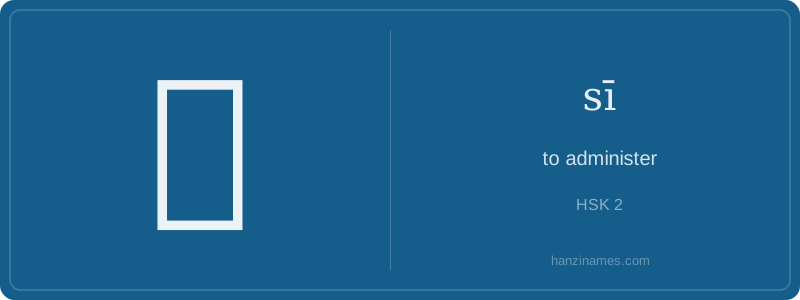
In modern Chinese, 司 appears most frequently in formal institutions and official titles: 法院 (fǎyuàn, 'court') uses 司法 (sīfǎ, 'judicial') to denote the branch that administers justice; 公安局 (gōng’ānjú, 'Public Security Bureau') oversees 司令部 (sīlìngbù, 'command headquarters') in military contexts. A well-documented idiom is 司空见惯 (sīkōngjiànguàn), meaning 'so common as to be taken for granted'—originally referencing a Tang-dynasty official title (Sikong) so routine it lost novelty.
The earliest attested form of 司 in bronze inscriptions (c. 11th–3rd c. BCE) depicts a hand guiding something toward a bounded space—interpreted by scholars like Li Xiaoding as 'directing affairs within a defined sphere'. No oracle-bone pictograph of a person 'speaking' exists; instead, 口 here functions as a symbolic enclosure representing jurisdiction—not vocalization.
Our detective work begins with the oracle-bone and bronze inscriptions of the Shāng and Zhōu dynasties—where 司 first appears not as a standalone verb, but as part of official titles like 司馬 (sīmǎ, 'Master of Horses'), denoting a royal officer in charge of military logistics. The character’s early form shows a hand (-like component) directing or overseeing something entering a mouth-like enclosure (口), suggesting authoritative supervision—not speech, but command over resources or personnel.
By the Warring States period, 司 evolved into a functional verb meaning 'to manage' or 'to administer', shedding its exclusively aristocratic connotation. Its radical 口 (kǒu, 'mouth') is misleading at first glance—it doesn’t signify speaking, but rather symbolizes an administrative unit, boundary, or designated domain under oversight. This aligns with ancient bureaucratic practice: officials didn’t just speak—they governed defined jurisdictions, often marked by gates or seals.
Modern Standard Chinese retains this core sense of stewardship and responsibility. Though rarely used alone today, 司 thrives in compound nouns and formal verbs like 主管 (zhǔguǎn) and 管理 (guǎnlǐ), reinforcing its semantic niche: delegated, institutional authority. Its five-stroke simplicity belies centuries of administrative weight—making it a quiet cornerstone of China’s bureaucratic lexicon, from imperial ministries to today’s State Administration for Market Regulation (国家市场监督管理总局).
Example Sentences
Common Compounds
Similar Characters — Don't Mix These Up
Your First Step into Chinese Culture: Get a Chinese Name
Every journey into Chinese begins with a name. Use our free Chinese name generator to create a meaningful, personalized Chinese name that fits you perfectly.
Get My Chinese Name →