淋
Character Story & Explanation
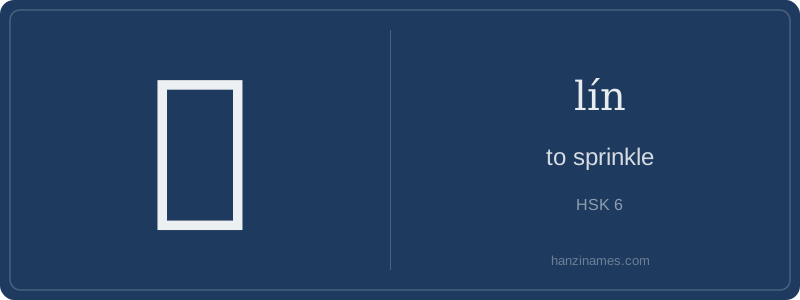
In daily life, 淋 is most commonly heard in phrases like 淋浴 (línyù, 'shower')—a ubiquitous term in Chinese homes, gyms, and hotels—and in food preparation, such as 淋油 (línyóu, 'drizzling oil over dishes'), a key technique in Jiangsu and Zhejiang cuisines. It also appears in the medical term 淋巴 (línbā, 'lymph'), borrowed from Japanese scientific terminology in the early 20th century. A well-documented idiom is 淋漓尽致 (línlí jìnzhì), meaning 'vividly and thoroughly', often used to praise expressive calligraphy or impassioned speeches.
The character is not pictographic; its form evolved from seal script where 氵 + 林 represented phonetic-semantic composition. 林 provided sound (lín), while 氵 indicated meaning related to water. No oracle bone or bronze inscriptions contain 淋—it first appeared reliably in Han dynasty bamboo slips and medical manuscripts, confirming its origin as a later, functional compound for describing fluid dynamics.
The character 淋 (lín) evokes the gentle yet persistent action of liquid falling or flowing over a surface—like raindrops tracing paths down a steamed-up bathroom mirror, or cold water cascading over hot stones in a traditional Chinese sauna. Its left radical 氵 (three-dot water) immediately signals a connection to liquids, while the right component 林 (lín, 'forest') suggests repetition and density—just as trees stand in rows, so too do droplets fall in succession. This visual duality captures both motion and multiplicity.
Historically, 淋 appears in medical texts like the Bencao Gangmu (1596), where it describes the dripping of herbal decoctions or bodily fluids—a usage preserved today in terms like 淋病 (lìnbìng, gonorrhea), reflecting its association with discharge. The character’s dual pronunciation (lín/lìn) marks functional distinction: lín is descriptive (to sprinkle, drip), while lìn is causative or intensified (to drench thoroughly, to soak).
In modern Mandarin, 淋 is rarely used alone but thrives in compound verbs and technical contexts. It carries subtle connotations of uncontrolled or continuous flow—not a single splash, but sustained contact: think of rinsing vegetables under running water (淋菜), applying hair dye evenly (淋染), or even the emotional ‘drenching’ in literary metaphors like 泪水淋漓 (lèishuǐ línlí, tears streaming copiously). Its HSK Level 6 status reflects its nuanced, context-dependent usage rather than frequency.
Example Sentences
Common Compounds
Similar Characters — Don't Mix These Up
Your First Step into Chinese Culture: Get a Chinese Name
Every journey into Chinese begins with a name. Use our free Chinese name generator to create a meaningful, personalized Chinese name that fits you perfectly.
Get My Chinese Name →