混
Character Story & Explanation
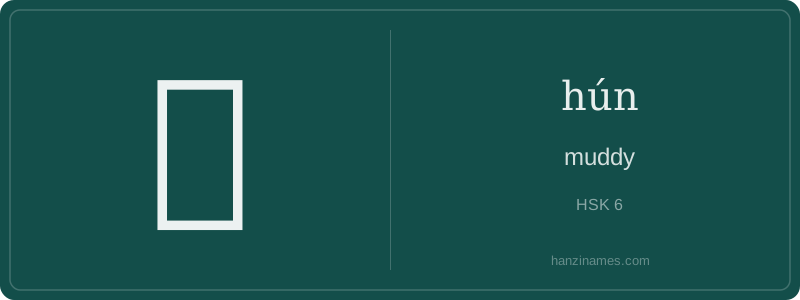
Historically, 混 appears in Daoist cosmology — most famously in the phrase 混沌 (hùn dùn), describing the undifferentiated, formless state before heaven and earth separated. This usage is well-documented in texts like the Zhuangzi (c. 4th century BCE). Today, 混 is ubiquitous in colloquial speech: 混圈子 (hùn quān zi, 'to mingle in social circles'), 混日子 (hùn rì zi, 'to idle away time'), and the idiom 鱼龙混杂 (yú lóng hùn zá, 'fish and dragons mixed together' — meaning 'a motley, unsorted group').
The character’s form is not pictographic but phono-semantic: the left side 氵 (water) signals meaning; the right side 昆 (kūn) originally indicated pronunciation and also carries connotations of 'together' or 'all-encompassing' — fitting its core idea of mixing or indistinctness. No oracle-bone form survives, but its seal-script version (c. 3rd century BCE) already shows this structure.
Hi students! Let’s explore 混 (hún/hùn), a character that literally means 'muddy' or 'turbid' — like water clouded with silt. It belongs to the water radical (氵), telling us right away it relates to liquids, flow, or states of clarity. Though its basic meaning is physical murkiness, in modern Chinese it’s far more active as a verb meaning 'to mix', 'to confuse', or even 'to get by' — showing how Chinese often extends concrete ideas into abstract, everyday expressions.
Don’t be surprised that 混 has two standard pronunciations: hùn (more common) and hún (used in classical or poetic contexts, like 混沌 hùn dùn / hún dùn for 'primordial chaos'). In speech, hùn dominates — especially in verbs like 混饭吃 (hùn fàn chī, 'to eke out a living'). This duality reflects how Mandarin preserves layered historical usage while adapting to daily needs.
As an HSK Level 6 character, 混 appears in advanced vocabulary involving ambiguity, blending, or social navigation — not just literal dirt in water. Think of it as a 'semantic bridge': from visual murkiness → conceptual confusion → pragmatic survival ('mixing in' to get by). Mastering it helps you understand subtle tones in spoken Chinese — like when someone says 我就混着吧 (Wǒ jiù hùn zhe ba), meaning 'I’ll just muddle through', with gentle self-deprecation, not laziness.
Example Sentences
Common Compounds
Similar Characters — Don't Mix These Up
Your First Step into Chinese Culture: Get a Chinese Name
Every journey into Chinese begins with a name. Use our free Chinese name generator to create a meaningful, personalized Chinese name that fits you perfectly.
Get My Chinese Name →