淹
Character Story & Explanation
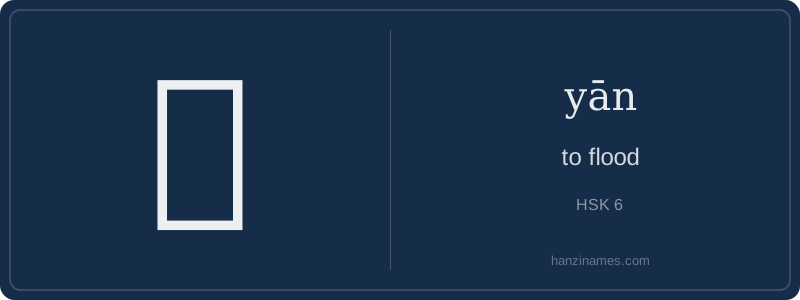
淹 is used primarily in formal, written, or technical contexts—not daily speech. It appears in news reports (e.g., '农田被淹' — farmland submerged), historical records of disasters, and classical literature. A well-documented idiom is 淹没 (yānmò, 'to submerge/obliterate'), frequently used in environmental reporting and heritage preservation discourse (e.g., Three Gorges Dam reservoir submerging ancient sites). The term also appears in legal texts concerning flood-related liability.
The character evolved from seal script (c. 3rd century BCE), where it already combined 氵 and 掩. No oracle bone form survives. Its modern shape reflects standardized clerical script simplification—no pictographic origin remains visible. Today, Chinese people encounter 淹 most often in weather alerts, geography textbooks, or museum plaques describing drowned archaeological sites.
The Chinese character 淹 (yān) conveys the idea of submersion or inundation—literally, water overwhelming something. Its left radical 氵 (three-dot water) signals a strong connection to liquid, while the right component 掩 (yǎn) suggests covering or concealing, reinforcing the sense of being buried or overwhelmed by water. Unlike English 'flood', which can be noun or verb, 淹 is strictly a transitive verb meaning 'to flood (something)' or 'to submerge'.
Western equivalents like 'flood', 'inundate', or 'deluge' carry overlapping but distinct nuances: 'flood' is neutral and common; 'inundate' implies overwhelming quantity (often metaphorically); 'deluge' evokes biblical scale and drama. 淹 lacks the idiomatic versatility of 'inundate' in business jargon ('inundated with emails') but appears in formal, literary, or disaster-reporting contexts—never in casual slang.
Culturally, flooding in China carries deep historical resonance: the Yellow River’s 'China’s Sorrow' floods shaped dynastic policy, hydraulic engineering, and Confucian governance ideals. 淹 thus evokes not just physical water but systemic vulnerability—echoing Western metaphors like 'swamped' or 'drowned in debt', yet grounded in millennia of river management and agrarian survival.
Example Sentences
Common Compounds
Similar Characters — Don't Mix These Up
Your First Step into Chinese Culture: Get a Chinese Name
Every journey into Chinese begins with a name. Use our free Chinese name generator to create a meaningful, personalized Chinese name that fits you perfectly.
Get My Chinese Name →