涌
Character Story & Explanation
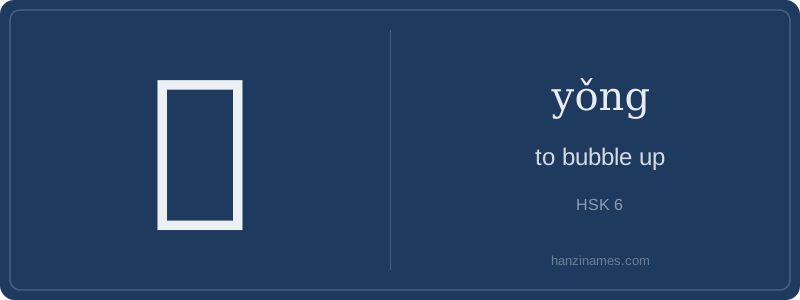
涌 is widely used in modern Chinese media and literature to describe rapid, collective emergence—e.g., ‘人流涌向地铁站’ (crowds surge toward the subway station), a phrase seen in Beijing Daily reports during rush hour. It appears in the idiom 暗流涌动 (àn liú yǒng dòng, 'undercurrents surging'), frequently used in political and economic analysis since the 1990s (e.g., Xinhua coverage of market shifts). The character also appears in geographical names like 钱塘江大潮涌 (Qiantang River tidal bore), documented since Song dynasty records.
The written form is a standard semantic-phonetic compound: 氵 (water) + 甬 (yǒng, phonetic and evocative of a vertical conduit). 甬 itself originated as a pictograph of a bell-shaped ceremonial tube in bronze inscriptions—later repurposed for sound. No oracle-bone form of 涌 exists; its earliest attestation is in Han-era bamboo slips (c. 2nd century BCE), confirming its post-classical development.
Our detective begins at the crime scene: the character 涌. At first glance, it’s a water radical (氵) paired with a phonetic component 拥 (yōng), but wait—the modern form uses 甬 (yǒng), not 拥. This is key. The left side 氵 unmistakably signals water-related action—flow, surge, emergence. The right side 甬 was historically a pictograph of a bell-shaped conduit or hollow tube, suggesting upward channeling. So visually, 涌 implies liquid forced upward through a narrow passage—exactly what ‘to bubble up’ feels like.
Zooming in on paleographic evidence: in early clerical script (Lìshū, c. 200 BCE–200 CE), 涌 appears with clear water strokes and a simplified 甬, confirming its semantic-phonetic structure (形声字). It was never a pure pictograph—but a calculated fusion: water + sound/shape hinting at constrained upward motion. No oracle bone or bronze inscriptions bear 涌; it emerged later, likely during the Han dynasty, as Chinese needed precise verbs for dynamic hydrological phenomena—geysers, spring surges, emotional outbursts.
The character’s evolution reflects linguistic pragmatism. As Classical Chinese matured, writers required verbs beyond generic ‘flow’ (流) or ‘rise’ (升). 涌 filled that niche: sudden, voluminous, upward-directed emergence—whether literal (a spring bursting forth) or metaphorical (tears welling, crowds surging). Its HSK 6 status confirms its role in advanced expression: not daily vocabulary, but essential for literary fluency, journalism, and formal description where nuance matters. It’s the verb you reach for when something *cannot be contained*.
Example Sentences
Common Compounds
Similar Characters — Don't Mix These Up
Your First Step into Chinese Culture: Get a Chinese Name
Every journey into Chinese begins with a name. Use our free Chinese name generator to create a meaningful, personalized Chinese name that fits you perfectly.
Get My Chinese Name →