渗
Character Story & Explanation
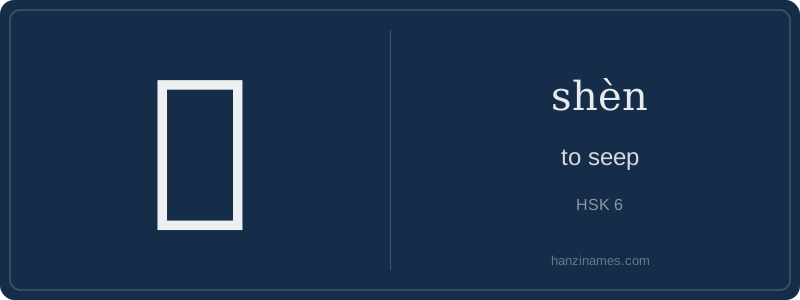
渗 is widely used in modern Chinese technical and administrative contexts—especially in hydrology, construction, and environmental regulation. The Ministry of Ecology and Environment’s official documents frequently use 渗漏 (shèn lòu, 'seepage/leakage') when reporting groundwater contamination or dam integrity assessments. It also appears in the national standard GB 50141–2021 on water treatment structures, specifying permissible 渗水量 (shèn shuǐ liàng, 'seepage volume').
Visually, 渗 is a phono-semantic compound: left side 氵 (water radical) indicates meaning; right side 参 (cān/shēn) provides phonetic cue (though pronunciation has diverged slightly). First attested in the Kangxi Dictionary (1716), it shows no oracle-bone or bronze script forms—its earliest verified usage is in Song-dynasty texts describing irrigation and dyeing techniques where liquid penetration was critical.
The Chinese character 渗 (shèn) conveys the slow, gradual penetration of a liquid—or metaphorically, an idea or influence—through a porous medium. Unlike English 'leak', which often implies unintended loss or failure, 渗 carries neutral or even positive connotations in contexts like groundwater recharge or cultural diffusion. Its water radical (氵) immediately signals fluidity and permeability, anchoring the meaning in physical reality while allowing rich figurative extension.
In Western environmental science, 'seepage' is a precise technical term—used in hydrogeology for subsurface water movement—but lacks the lexical flexibility of 渗. English rarely uses 'seep' transitively with abstract objects (e.g., 'hope seeps into society'), whereas 渗 routinely appears this way in formal Chinese writing, especially in policy documents or literary essays about social change.
Culturally, 渗 reflects a distinctly Chinese epistemology: change as quiet, persistent infiltration rather than abrupt rupture. This resonates with Daoist and Confucian ideals of gradual cultivation—like virtue 'seeping' through education (潜移默化, qián yí mò huà). In contrast, Western metaphors often favor visibility and agency ('spread', 'impose', 'instill'), making 渗 a subtle yet profound linguistic window into China’s temporal and relational worldview.
Example Sentences
Common Compounds
Similar Characters — Don't Mix These Up
Your First Step into Chinese Culture: Get a Chinese Name
Every journey into Chinese begins with a name. Use our free Chinese name generator to create a meaningful, personalized Chinese name that fits you perfectly.
Get My Chinese Name →