漆
Character Story & Explanation
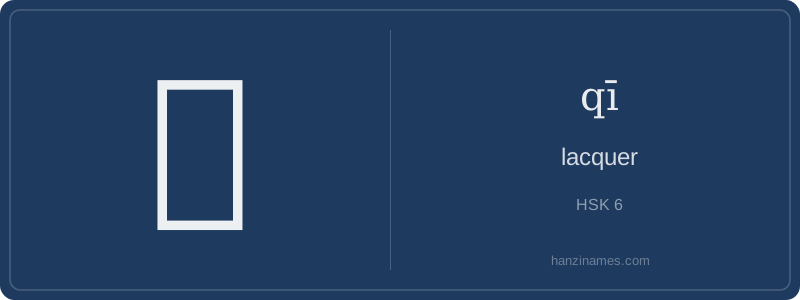
In daily life, 漆 most commonly appears in terms like 油漆 (yóuqī, 'paint') and 漆器 (qīqì, 'lacquerware'), used by carpenters, restorers, and museum curators across China. Historically, it was central to imperial workshops—the Ming-era *Tiangong Kaiwu* details lacquer harvesting techniques, and the Forbidden City’s carved red lacquer screens remain iconic. A well-known idiom is 漆黑一片 (qīhēi yīpiàn), meaning 'pitch black', directly referencing lacquer’s signature depth of color.
The character’s form is not pictographic but phono-semantic: the left radical 氵 ('water') indicates its liquid state when raw; the right component 七 (qī) provides pronunciation. No oracle bone or bronze script forms survive—its earliest attestation is in Warring States bamboo slips (4th c. BCE), where it consistently denotes processed lacquer, not generic paint.
As an archaeologist brushing dust from a lacquered Han dynasty cosmetic box—its vermilion surface still gleaming after two millennia—I recognize 漆 not as mere 'paint,' but as the lifeblood of ancient Chinese material culture. This character encodes the labor-intensive extraction of sap from the Toxicodendron vernicifluum tree, a process documented in the *Rites of Zhou* (c. 3rd century BCE). Its radical 氵 (water) reflects the viscous, liquid nature of raw lacquer before curing—a substance so vital it was taxed, traded along Silk Road routes, and buried with elites as status objects.
The character’s 14 strokes conceal a layered history: the right side 七 (qī, 'seven') is phonetic, while the left 氵 signals fluidity—but crucially, not water-based pigment. Unlike European oils or tempera, Chinese lacquer is a urushiol-rich resin that polymerizes via humidity and warmth, forming an impervious, glossy film. Excavations at Mawangdui revealed over 180 lacquerware pieces, all labeled with ink inscriptions using 漆—proving its lexical centrality in artisanal administration and workshop records.
By the Tang dynasty, 漆 had expanded semantically beyond the material to denote refinement and durability—hence idioms like 漆黑 (qīhēi, 'lacquer-black') for absolute darkness, evoking the deep, light-swallowing gloss of cured lacquer. Its HSK-6 status reflects this semantic density: learners must grasp not only its literal use in art conservation or furniture restoration, but also its metaphorical weight in classical texts describing moral incorruptibility ('as unblemished as cured lacquer').
Example Sentences
Common Compounds
Similar Characters — Don't Mix These Up
Your First Step into Chinese Culture: Get a Chinese Name
Every journey into Chinese begins with a name. Use our free Chinese name generator to create a meaningful, personalized Chinese name that fits you perfectly.
Get My Chinese Name →