潜
Character Story & Explanation
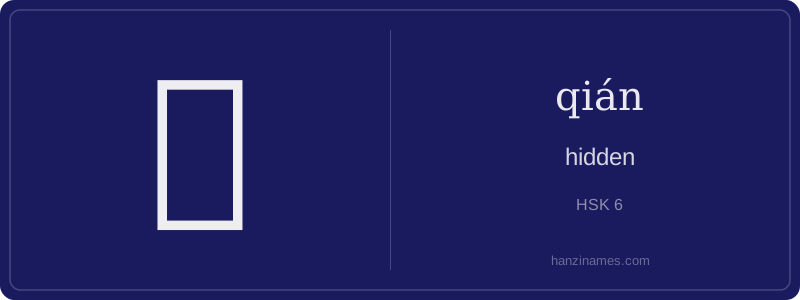
In modern Chinese, 潜 appears widely in technical, academic, and political discourse: '潜规则' (qián guīzé, 'hidden rules') describes unofficial yet pervasive social norms in business or bureaucracy; '潜水' (qiánshuǐ) is internet slang for 'lurking'—reading online forums without posting. The idiom '潜移默化' (qián yí mò huà, 'gradual, imperceptible influence') is taught in HSK 6 textbooks and appears in official education policy documents regarding moral cultivation.
The character evolved from seal script, where it combined 氵 (water) and 曰 (a variant of 廾 + 口, later simplified to 曰), originally suggesting 'to sink into water'. While its earliest attestation is in Warring States bamboo texts (e.g., *Shanghai Museum Bamboo Slips*, c. 4th century BCE), it consistently denoted physical submersion before extending metaphorically during the Han dynasty—documented in texts like *Huainanzi*.
The character 潜 (qián) embodies the idea of something concealed, submerged, or operating beneath the surface—whether physically, like diving underwater, or metaphorically, like latent talent or hidden motives. Its water radical (氵) signals a connection to depth and fluidity, while the phonetic component 曰 (yuē, though altered) hints at its pronunciation. Unlike English words such as 'hidden' or 'secret', which emphasize static concealment, 潜 conveys dynamic, intentional submersion—often with purpose, preparation, or strategic patience.
In Chinese philosophy and governance, 潜 reflects Confucian and Daoist ideals: the sage who remains 'unseen' until the right moment (e.g., 《易经》'潜龙勿用' — 'The hidden dragon should not act'), echoing Western concepts like Aristotle’s 'potentiality' (dynamis) or the Stoic ideal of reserved virtue. Yet unlike Western notions of secrecy—which can carry moral ambiguity—潜 is often neutral or even laudatory, implying wisdom in restraint.
Western equivalents include 'latent' (scientific), 'submerged' (physical), and 'incognito' (social), but none fully capture 潜’s blend of agency, environment, and temporality. A submarine '潜航' (qiánháng) doesn’t just hide—it navigates purposefully in a medium; a scholar '潜心研究' (qiánxīn yánjiū) doesn’t merely study quietly—they immerse mind and effort deeply. This duality—environmental immersion + volitional concealment—is culturally central and linguistically precise.
Example Sentences
Common Compounds
Similar Characters — Don't Mix These Up
Your First Step into Chinese Culture: Get a Chinese Name
Every journey into Chinese begins with a name. Use our free Chinese name generator to create a meaningful, personalized Chinese name that fits you perfectly.
Get My Chinese Name →