溃
Character Story & Explanation
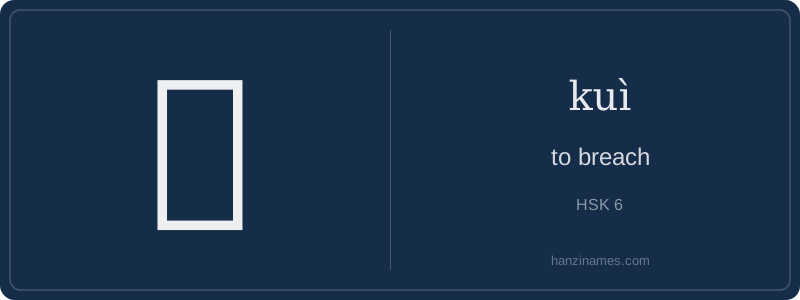
溃 appears in classical texts like the Records of the Grand Historian (Shǐjì) describing failed river defenses and military routs. Today, it’s most common in formal contexts: news reports on troop withdrawals (溃退 kuìtuì), economic analyses of market panic (溃散 kuìsàn), and medical terminology for tissue necrosis (溃烂 kuìlàn). The idiom 土崩瓦解 (tǔbēng wǎjiě, 'like earth crumbling and tiles shattering') often pairs with 溃 to emphasize total disintegration.
The character is not pictographic but phono-semantic: 氵 (water radical) + 贵 (guì, phonetic, though sound has shifted). No oracle bone or bronze script form survives; its earliest attestation is in Warring States bamboo slips (c. 4th century BCE), consistently used for hydraulic and military failure—confirming its ancient association with controlled systems failing catastrophically.
The Chinese character 溃 (kuì) originally depicted the catastrophic failure of a water containment structure—specifically, a dam or dike breaking under pressure. Its radical 氵 (water) signals this hydrological origin, while the phonetic component 贵 (guì) provides pronunciation cues. In classical usage, it described literal breaches in flood control systems—a matter of life-and-death importance in agrarian China’s Yellow River basin, where dike failures caused massive displacement and famine.
Over time, 溃 extended metaphorically to describe systemic collapse: military defeats (e.g., an army ‘disintegrating’), institutional breakdown, or psychological unraveling. Unlike English ‘collapse’, which is neutral or physical, 溃 carries connotations of sudden, irreversible rupture after accumulated stress—akin to a dam holding back immense force until it catastrophically yields.
In Western cultural equivalents, ‘breach’ (legal/military) or ‘rupture’ (medical) come closest—but lack 溃’s visceral hydrological imagery and moral weight. The biblical ‘floodgates opened’ evokes similar drama, yet lacks the technical precision of 溃 as a civil engineering term. Even ‘crack’ or ‘breakdown’ undersells its implication of structural failure following sustained pressure—making 溃 uniquely resonant in contexts like crisis management, military history, or mental health discourse in Chinese.
Example Sentences
Common Compounds
Similar Characters — Don't Mix These Up
Your First Step into Chinese Culture: Get a Chinese Name
Every journey into Chinese begins with a name. Use our free Chinese name generator to create a meaningful, personalized Chinese name that fits you perfectly.
Get My Chinese Name →