涩
Character Story & Explanation
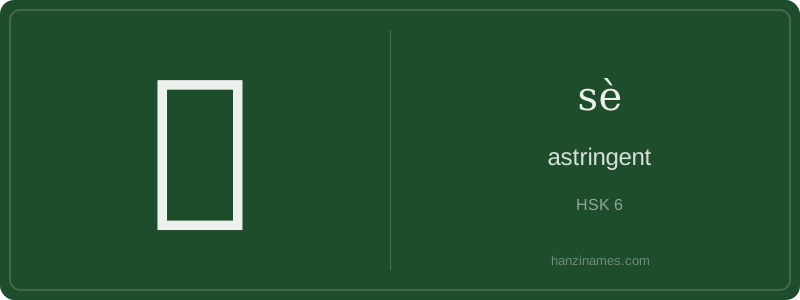
In daily life, 涩 most commonly describes taste (e.g., unripe persimmons, strong green tea) and texture (e.g., chalky lipstick, drying skincare). It appears in the idiom 苦涩 (kǔ sè, ‘bitter-astringent’), used metaphorically for painful, lingering regret — widely attested in modern literature and news headlines. Historically, Song-dynasty pharmacopoeias listed 涩 as a key property of herbs like pomegranate rind, prescribed to ‘bind and check leakage’ (e.g., diarrhea).
The character’s form is not pictographic but phono-semantic: 氵 (water radical, semantic) + sè (sound component derived from 塞, itself meaning ‘to block’). No oracle-bone or bronze script forms survive; its earliest confirmed appearance is in Han-dynasty bamboo slips (2nd c. BCE), consistently with the ‘blocking’ semantic core.
As an archaeologist brushing dust from a Tang-dynasty tea manual, I found 涩 etched beside inked notes on unfermented pu’er — not as a defect, but as a prized sensory marker. Its water radical (氵) hints at moisture’s role in triggering the mouth-puckering reaction: tannins binding salivary proteins. This isn’t mere bitterness; it’s tactile resistance — a dry, tightening sensation documented in 8th-century medical texts as both physiological effect and diagnostic clue.
The ten-stroke structure reveals layered meaning: 氵 (water) + 刂 (knife-like severing action) + 塞 (to block, seal). Together, they encode the physical experience of astringency — liquid encountering obstruction, flow impeded, mouth ‘sealed’ by contraction. Early dictionaries like the Shuōwén Jiězì (121 CE) classified it under ‘taste-related impediments’, linking it to herbal efficacy, not flavor alone.
Modern linguistic excavation shows 涩 evolved beyond botany and medicine into metaphor: a ‘涩’ voice implies hoarseness or emotional constriction; ‘涩’ art denotes deliberate roughness or unresolved tension. Its HSK 6 status reflects this semantic density — learners don’t just memorize ‘astringent’; they uncover a cultural grammar of restraint, resistance, and embodied perception encoded over two millennia.
Example Sentences
Common Compounds
Similar Characters — Don't Mix These Up
Your First Step into Chinese Culture: Get a Chinese Name
Every journey into Chinese begins with a name. Use our free Chinese name generator to create a meaningful, personalized Chinese name that fits you perfectly.
Get My Chinese Name →