澄
Character Story & Explanation
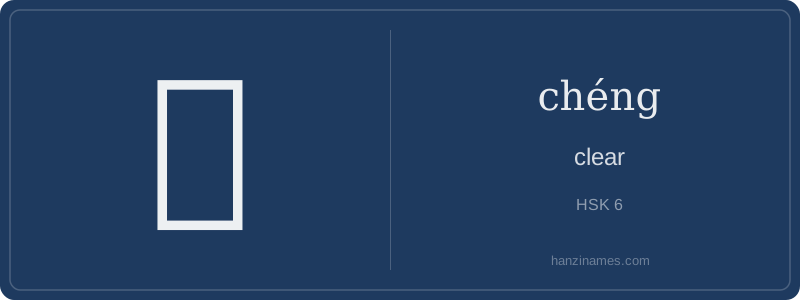
In modern usage, 澄 appears most frequently in formal and literary registers: in journalism (e.g., 澄清事实 'clarify the facts'), education (e.g., 澄清概念 'clarify a concept'), and official discourse to denote the act of dispelling confusion or misinformation. It’s central to the idiom 澄清谬误 (chéngqīng miùwù), used in government white papers since the 1980s to describe ideological rectification. The compound 澄澈 (chéngchè), meaning 'crystal-clear', is common in descriptive writing about lakes and mountain streams—especially in nature essays published by China’s State Forestry Administration.
The character’s form is not pictographic but phono-semantic: the left radical 氵 signals water-related meaning; the right component 登 (dēng) provides phonetic approximation (both 登 and 澄 historically shared similar Middle Chinese rimes). No oracle bone or bronze inscription form exists—its earliest verified appearance is in Warring States bamboo slips from the Guodian cache (c. 300 BCE), confirming its origin as a late Zhou-era constructed character for abstract conceptual clarity.
As an archaeologist sifting through layers of linguistic sediment, I uncover 澄 not as a static glyph but as a hydrological artifact—its three-dot water radical (氵) anchoring it firmly in the ancient Chinese worldview where water was both physical medium and philosophical metaphor. The right side, 登 (dēng), originally depicted ascending steps or a ceremonial platform, suggesting elevation, attainment, and ritual purification. Together, they encode an early concept: water made pure *through rising action*—not passive stillness, but active clarification.
This character’s earliest secure attestation appears in the Warring States bamboo texts (4th c. BCE), where it describes rivers visibly cleared after floods—a documented environmental observation, not myth. Later, in Han dynasty commentaries on the *Classic of Filial Piety*, 澄 surfaces in metaphors for moral discernment: ‘clarifying the heart-mind like still water’. Its semantic range expanded precisely because clarity was never just optical—it implied ethical transparency, intellectual rigor, and administrative integrity.
The dual pronunciation chéng/dèng reflects historical phonological stratification: chéng represents the dominant literary reading (used in compounds and formal contexts), while dèng survives as a rare colloquial or dialectal variant—attested in Ming-era local gazetteers describing well-water clarity in Shandong. This bifurcation isn’t random; it mirrors how bureaucratic standardization (chéng) coexisted with regional speech (dèng), preserving layered sociolinguistic strata within a single character.
Example Sentences
Common Compounds
Similar Characters — Don't Mix These Up
Your First Step into Chinese Culture: Get a Chinese Name
Every journey into Chinese begins with a name. Use our free Chinese name generator to create a meaningful, personalized Chinese name that fits you perfectly.
Get My Chinese Name →