滨
Character Story & Explanation
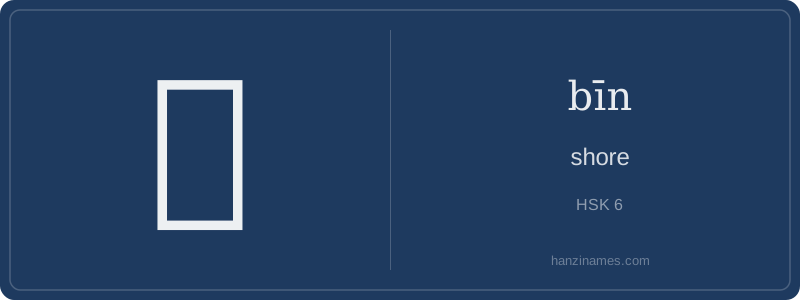
In modern Chinese, 滨 appears most frequently in proper nouns—especially city names like 青岛(Qīngdǎo)and 大连(Dàlián), both coastal cities whose official English branding uses 'Binhai' (e.g., Tianjin Binhai New Area). It’s also central in the idiom 濒临绝境 (bīnlín juéjìng, 'on the verge of desperation'), though note that 濒 is distinct—it shares pronunciation but carries a more abstract 'verge-of' sense. The character is rare in everyday verbs or adjectives, appearing mainly in formal, literary, or toponymic contexts.
Historically, 滨 derives from the small seal script (xiǎozhuàn) form of the Qin dynasty, where the water radical was standardized as three dots (氵) instead of the earlier full 'water' character (水). The right side 宾 was already phonetic by then—no pictorial origin remains; it’s purely a phono-semantic compound. Today, Chinese students encounter it first in HSK 6 reading passages about geography or environmental policy.
As an archaeologist brushing dust from a Han dynasty bamboo slip, I find 滨 etched not as a grand oracle-bone glyph—but as a deliberate, water-bound compound. Its left radical 氵—three flowing strokes—dates back to the Warring States period, symbolizing liquid movement, while the right component 宾 (bīn) originally meant 'guest' or 'to receive', evoking ritual hospitality offered at sacred riverbanks. This pairing suggests early Chinese cosmology: the shore was not mere geography but a liminal threshold where humans met nature’s power.
The character’s 13-stroke form crystallized during the Qin standardization of script. Unlike pictographic predecessors, 滨 is semantic-phonetic: 氵 signals water-related meaning; 宾 provides pronunciation and subtle connotation—'a place where one is received by the water'. Excavated texts from Mawangdui (2nd c. BCE) use it in geographical registers listing riverside settlements, confirming its administrative function long before poetic adoption.
By the Tang dynasty, 滨 evolved beyond topography into metaphor: poets like Wang Wei used it to evoke transience and quiet contemplation—‘the misty shore’ (烟滨) implied both physical edge and existential boundary. Modern excavations of Dunhuang manuscripts show scribes carefully distinguishing 滨 from similar characters like 濒 (bīn, ‘on the verge of’), proving orthographic precision mattered even in Buddhist sutra copying—where context demanded precise spatial nuance.
Example Sentences
Common Compounds
Similar Characters — Don't Mix These Up
Your First Step into Chinese Culture: Get a Chinese Name
Every journey into Chinese begins with a name. Use our free Chinese name generator to create a meaningful, personalized Chinese name that fits you perfectly.
Get My Chinese Name →