溅
Character Story & Explanation
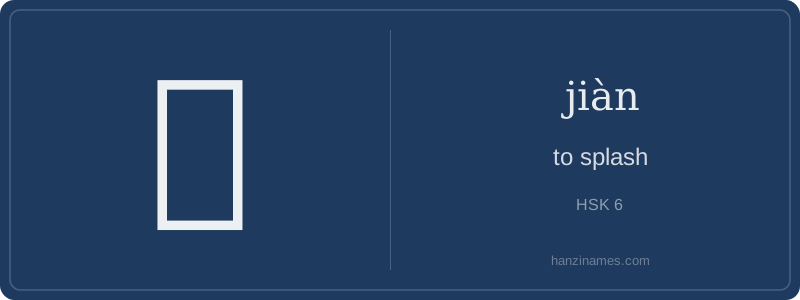
溅 is commonly used in descriptive writing and media — especially in weather reports (‘雨水溅到脸上’), cooking shows (‘热油溅出’), and safety warnings (‘小心液体溅出’). It appears in the famous Tang poem ‘The Ballad of Mulan’, where 溅溅 describes the gurgling, splashing sound of a flowing river (‘不闻爷娘唤女声,但闻黄河流水鸣溅溅’). This onomatopoeic usage is well-documented in classical texts and remains standard today.
The character evolved from seal script, where the left side clearly represented ‘water’ (氵), and the right was a simplified form of 賤 — chosen purely for sound. There’s no pictographic origin (like a droplet); instead, it’s a phono-semantic compound standardized by the Qin dynasty and preserved in the Kangxi Dictionary. Modern usage prioritizes its dynamic, sensory quality — think of a chef warning ‘小心热油溅!’ (Watch out — hot oil is splattering!).
Hi students! Let’s learn 溅 (jiàn), a vivid verb meaning 'to splash' — like water jumping up when you drop a stone in a pond or rain hitting a hot sidewalk. It’s pronounced with the fourth tone: jiàn (like 'jian' in 'Jiang' but sharp and falling). Though it’s an HSK Level 6 character, its meaning is intuitive once you see it in action — always involving sudden, forceful movement of liquid outward.
This character belongs to the water radical 氵, which appears on the left and tells us immediately that the word relates to liquids or fluid motion. The right side, 贱 (jiàn), is a phonetic component — it hints at pronunciation but *not* meaning (don’t confuse it with ‘cheap’ or ‘lowly’, which is what 贱 means alone!). In Chinese, many characters use this ‘sound-plus-sign’ logic, so focus on the radical first for meaning clues.
Remember: 溅 is almost always used as a verb — never as a noun or adjective. It often appears with onomatopoeic reduplication (e.g., 溅溅) in classical poetry, or in modern compound verbs like 溅起 (to splash up) or 溅湿 (to splash and wet). You’ll rarely see it alone in speech; it loves company — especially verbs of motion or result complements!
Example Sentences
Common Compounds
Similar Characters — Don't Mix These Up
Your First Step into Chinese Culture: Get a Chinese Name
Every journey into Chinese begins with a name. Use our free Chinese name generator to create a meaningful, personalized Chinese name that fits you perfectly.
Get My Chinese Name →