濒
Character Story & Explanation
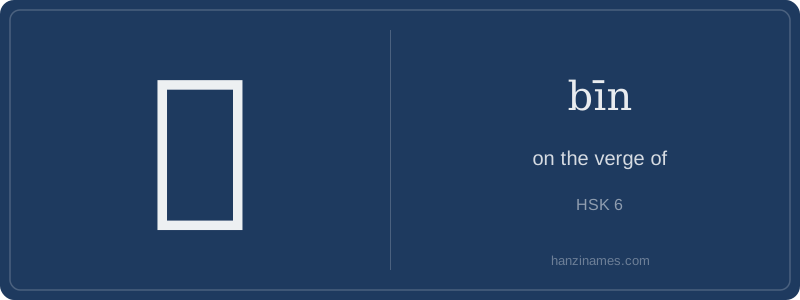
In contemporary Chinese, 濒 is almost exclusively used in formal, high-stakes contexts—especially environmental science, law, and diplomacy. It appears in official reports (e.g., China’s Red List of Endangered Species uses '濒危物种'), news headlines ('中美关系濒临破裂'), and policy documents. It rarely occurs in casual speech; native speakers typically avoid it outside written or rhetorical registers. Its most frequent collocation is 濒临 (bīnlín), meaning 'to be on the verge of'—a phrase documented in modern standard Mandarin since the early 20th century.
The character’s form is well-documented: 濒 is a phono-semantic compound. Left radical 氵 (water) signals semantic association with fluid boundaries or thresholds (e.g., coastlines, edges); right component 频 (pín) provides phonetic cue (though tone shifted from second to first). This structure was standardized in the Shuōwén Jiězì (121 CE), where it was defined as 'to approach the water’s edge', later extended metaphorically to any critical brink.
As an archaeologist brushing dust from a Tang-dynasty stele, I found 濒 etched beside a crumbling riverbank inscription—its three water-drops (氵) unmistakably evoking the lapping edge of a floodplain. The right side, 频 (pín), originally depicted a person nodding repeatedly—a gesture of proximity, of repeated nearness. Here, the character doesn’t mean ‘at’ the water, but *on the verge of* it: not submerged, not distant, but trembling at the threshold.
This character is a temporal and spatial liminal marker—like finding footprints just before the tide erases them. In classical texts, 濒 appears in contexts of imminent crisis or transition: '濒危' (on the verge of extinction), '濒临' (to be on the point of). Its semantic weight lies not in arrival, but in the suspended moment *just before*—a linguistic artifact of urgency, fragility, and poised change.
Unlike static characters meaning 'near' (如 近 jìn), 濒 carries visceral tension. It’s the gasp before collapse, the hush before thunder. Modern usage preserves this gravity: scientists use it for ecosystems tipping into collapse; diplomats deploy it for treaties '濒临破裂' (on the verge of breaking down). Its 16 strokes map a journey—not of distance covered, but of thresholds crossed. To write 濒 is to trace the shoreline between certainty and consequence.
Example Sentences
Common Compounds
Similar Characters — Don't Mix These Up
Your First Step into Chinese Culture: Get a Chinese Name
Every journey into Chinese begins with a name. Use our free Chinese name generator to create a meaningful, personalized Chinese name that fits you perfectly.
Get My Chinese Name →