出
Character Story & Explanation
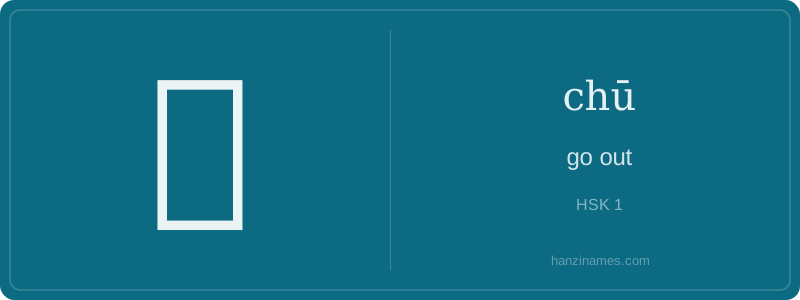
Historically, 出 appears in core administrative texts like the Qin bamboo slips from Shuihudi (1975 discovery), where it denotes official issuance—e.g., 出令 (chū lìng, 'issue an order') or 出赋 (chū fù, 'collect taxes'). In daily life, it’s ubiquitous: subway signs say ‘出口’ (chūkǒu, 'exit'), restaurants list ‘出品’ (chūpǐn, 'house specialty'), and parents tell children ‘出去玩’ (chūqù wán, 'go out to play'). The HSK 1 idiom ‘出生入死’ (chūshēng rùsǐ, 'born into life, enter death') reflects its ancient binary role: emergence vs. entry.
The character’s form is a documented pictograph: the top two horizontal strokes represent the ground or a threshold; the vertical stroke piercing them signifies crossing outward; the enclosing 凵 radical (a ‘container’ or ‘pit’) frames the act of emergence. No oracle bone variant survives, but bronze inscriptions from the late Western Zhou (c. 9th c. BCE) show this structure fully formed—making it one of Chinese writing’s most stable, functionally transparent glyphs.
As an archaeologist brushing dust from a Warring States bamboo slip, I find 出 etched with confident, angular strokes—no oracle bone precursors survive, but its form is unmistakably functional: two parallel lines (representing the ground or boundary) crossed by an upward stroke, then enclosed by the radical 凵 (kǎn), a pictograph of a pit or opening. This isn’t abstract symbolism—it’s cartographic pragmatism: a path emerging *from* containment.
Excavations at Shuixian County (Hubei) revealed Qin dynasty legal texts where 出 consistently marks administrative departures—tax grain ‘issued’ (出粮), prisoners ‘released’ (出狱). The character never meant ‘exit’ as mere motion; it encoded *authorized emergence*: sanctioned movement across thresholds—physical, bureaucratic, or metaphysical. Its semantic gravity predates dictionaries, embedded in bronze inscriptions as early as the late Western Zhou.
Modern paleography confirms 出 evolved minimally: seal script (c. 3rd c. BCE) already shows the five-stroke structure we use today. Unlike characters reshaped by clerical script reforms, 出 resisted simplification—its integrity was vital. When Han scribes tallied silk exports on wooden tallies, each 出 stamped beside a quantity wasn’t just ‘out’—it was accountability made visible: goods crossing the state’s fiscal boundary, witnessed and recorded.
Example Sentences
Common Compounds
Similar Characters — Don't Mix These Up
Your First Step into Chinese Culture: Get a Chinese Name
Every journey into Chinese begins with a name. Use our free Chinese name generator to create a meaningful, personalized Chinese name that fits you perfectly.
Get My Chinese Name →